What we are solvingSpecimen X is a freshly killed small mammal (a rodent such as the laboratory rat)
We must classify it from external features, describe its teeth and head features,
measure and process the lengths of the gut portions, explain the gut differences,
and draw the blood vessels of the left side of the abdomen
Chapter: Diversity of living organisms; Nutrition; Transport in animals (mammalian dissection)
Topic: Class Mammalia, dentition, sense organs, alimentary canal, abdominal blood vessels
(a)(i) (4 marks)Class:
MammaliaReasons (any three):
1. Body covered with fur (hair)
2. External ears (pinnae) present
3. Mammary glands with teats (nipples) on the ventral side
4. Long sensory hairs (vibrissae) on the snout
5. Teeth of different kinds (heterodont dentition)
6. Separate anal and urinogenital openings (no cloaca)
(a)(ii) (4 marks)The teeth show the adaptations of a gnawing herbivore (rodent):
1. Incisors are chisel-shaped with sharp cutting edges, for gnawing and cutting hard food
2. Hard enamel is on the front surface of the incisors only; the softer back wears faster, so the edge stays sharp
3. Incisors are open-rooted and grow continuously, replacing what is worn away
4. Canines are absent, leaving a gap (diastema) where the tongue and cheeks move food and the cheeks fold in while gnawing
5. Premolars and molars are broad with cusps / ridges for grinding plant material
(a)(iii) (5 marks)1. Large, movable external ears (pinnae) collect sound waves and direct them into the ear; they turn to locate the source of a sound
2. Large, bulging eyes on the sides of the head give a wide field of view to detect predators
3. Eyelids (and nictitating membrane) protect and moisten the eyes
4. Long vibrissae (whiskers) on the snout are sensitive to touch; they help the animal feel its way in the dark and in narrow burrows
5. Nostrils at the tip of a long pointed snout detect smells of food, mates and enemies early
6. A movable head on a distinct neck lets the sense organs be turned towards a stimulus
(b)(i) (6 marks)Procedure:
1. Pin the specimen ventral side up on a dissecting board; cut through the skin and body wall along the mid-ventral line and pin the flaps back
2. Tie a thread round the hepatic portal vein before freeing the gut, so little blood is lost
3. Cut the mesentery and stretch the canal (without pulling it) from the cardiac end of the stomach to the posterior end of the colon
4. Measure each portion along its outer (longer) curve with a thread and a ruler, in mm
Processing:
percentage length=full lengthlength of portion×100Sample readings (your own readings will differ):
full length=50+110+880+60+200=1300 mmileum: 1300880×100=67.7%| Portion(along outer part) | Length (mm) | Percentage length of each section |
|---|
| stomach | 50 | 3.8 |
| duodenum | 110 | 8.5 |
| ileum | 880 | 67.7 |
| caecum & appendix | 60 | 4.6 |
| colon | 200 | 15.4 |
| full length | 1300 | 100 |
Check: the percentages add up to 100 and the ileum is by far the longest portion
(b)(ii)Stomach (2½ marks)1. Short but wide, J-shaped sac: stores a large meal so the animal can feed quickly and retreat
2. Thick muscular wall churns food and mixes it with gastric juice
3. Food is held long enough for protein digestion by pepsin in acid conditions
4. Acid kills bacteria taken in with food
5. Pyloric sphincter at the narrow end releases food in small amounts
Duodenum (2 marks)1. Short U-shaped loop that holds the pancreas in its curve and receives bile and pancreatic juice
2. Here bile neutralises the acid food and emulsifies fats, and pancreatic enzymes start digestion of all food classes
Ileum (2 marks)1. Very long and coiled: food stays longer, so digestion is completed
2. Gives a very large surface area (with villi) for absorption of the products of digestion
Caecum and appendix (2 marks)1. Large blind sac: houses symbiotic bacteria that digest cellulose of the plant diet
2. Food stays there long enough for fermentation; some products are absorbed; the appendix has lymphoid tissue for defence
Colon (1½ marks)1. Fairly long: reabsorbs water and mineral salts from undigested food
2. Forms the faeces into dry pellets, conserving water
3. Some products of bacterial fermentation are absorbed
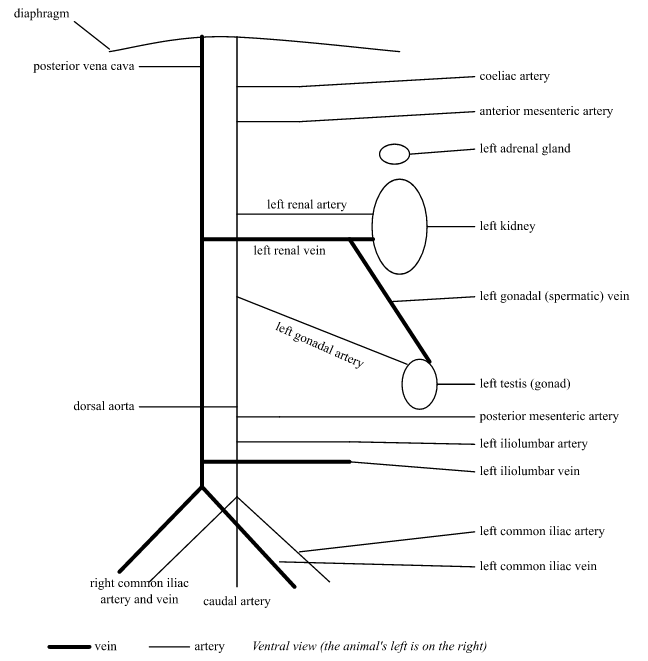
(c) (12 marks)Displace the gut to the animal's right and remove fat and connective tissue so that the vessels lying on the dorsal wall of the left side are seen
Label the main vessels: dorsal aorta, posterior vena cava, coeliac and anterior mesenteric arteries, left renal artery and vein,
left gonadal (spermatic or ovarian) artery and vein, posterior mesenteric artery, left iliolumbar artery and vein, left common iliac artery and vein, caudal artery
Drawing of the major blood vessels of the left side of the abdominal cavity of specimen X (ventral view)
In the rat the left gonadal vein drains into the left renal vein, not directly into the vena cava; in a female the gonad is an ovary
Draw in pencil with clear continuous lines; give a title; label with ruled lines that do not cross
Answer: (a) Mammalia; gnawing teeth with chisel incisors, diastema, no canines; sense organs adapted for wide perception. (b) Ileum longest (about two-thirds of the gut); percentages from length / full length × 100. (c) Labelled drawing of the left abdominal vessels.
Tip: Always show the calculation for one percentage and check that the column adds up to 100