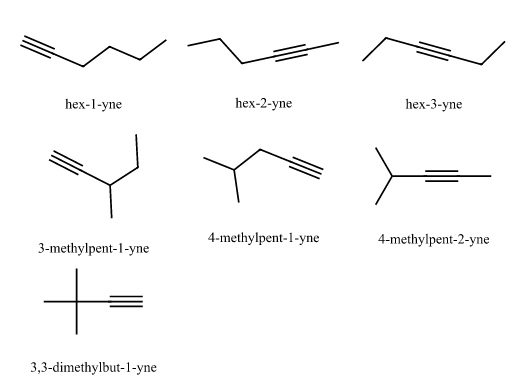
What we are solvingA hydrocarbon Z has 87.8 % C and 12.2 % H by massIt decolourises bromine water (unsaturated) and its vapour density is 41It gives a white precipitate with ammoniacal silver nitrateWe find its formulae, its isomers, identify it, and write its reactions with HBr and the mechanismChapter: Organic chemistry (hydrocarbons)Topic: empirical and molecular formulae, alkynes, electrophilic additionConcept and formulasMoles of each element =relative atomic massmass; divide by the smallest to get the simplest ratioMr=2×vapour densityn=empirical formula massMrOnly alkynes with a ≡C−H end (terminal alkynes) have an acidic H that silver(I) can replaceHBr adds to an unsymmetrical triple bond by Markovnikov's rule (H goes to the carbon that already has more H)With a peroxide the addition goes by free radicals and the orientation is reversed (anti-Markovnikov)Working(a)(i)(03 marks)Take 100 g of Z: 87.8 g C and 12.2 g HC:1287.8=7.317molH:112.2=12.2molDivide by the smaller number, 7.317C:H=1:1.667Multiply by 3 to get whole numbersC:H=3:5Empirical formula: C3H5(a)(ii)(2½ marks)Mr=2×41=82Empirical formula mass =3(12)+5(1)=41n=4182=2Molecular formula =(C3H5)2=C6H10It decolourises bromine water, so it has a C≡C (or two C=C) bond(b)(i)(01 mark)Z is an alkyne: general formula CnH2n−2 (n=6 gives C6H10)(b)(ii)(03 marks)The alkyne isomers of C6H10 (position and chain isomers):hex-1-yne: CH≡CCH2CH2CH2CH3hex-2-yne: CH3C≡CCH2CH2CH3hex-3-yne: CH3CH2C≡CCH2CH33-methylpent-1-yne: CH≡CCH(CH3)CH2CH34-methylpent-1-yne: CH≡CCH2CH(CH3)24-methylpent-2-yne: CH3C≡CCH(CH3)23,3-dimethylbut-1-yne: CH≡CC(CH3)3
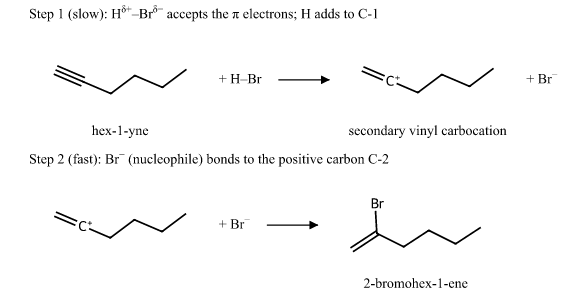
(c)(i)(01 mark)A white precipitate with ammoniacal silver nitrate shows a terminal alkyne (−C≡C−H)Part (c)(iii) makes it from 1-chlorobutane (a straight 4-carbon chain), so the chain is unbranchedZ is hex-1-yne, CH3CH2CH2CH2C≡CH(c)(ii)(1½ marks)The terminal H is replaced by silver; silver hex-1-ynide is the white precipitateCH3(CH2)3C≡CH(l)+[Ag(NH3)2](aq)+→CH3(CH2)3C≡CAg(s)+NH4+(aq)+NH3(aq)(c)(iii)(1½ marks)Step 1: make sodium ethynide from ethyne and sodium (in liquid ammonia)2HC≡CH+2Naliq. NH32HC≡CNa+H2Step 2: the ethynide ion displaces chloride from 1-chlorobutane (adds two carbons)CH3CH2CH2CH2Cl+NaC≡CH→CH3CH2CH2CH2C≡CH+NaCl(d)(i)(01 mark)Markovnikov addition (one mole of HBr):CH3(CH2)3C≡CH+HBr→CH3(CH2)3CBr=CH2Product: 2-bromohex-1-ene (with excess HBr it goes on to 2,2-dibromohexane, CH3(CH2)3CBr2CH3)(d)(ii)(01 mark)With a peroxide, Br adds to the end carbon (anti-Markovnikov):CH3(CH2)3C≡CH+HBrperoxideCH3(CH2)3CH=CHBrProduct: 1-bromohex-1-ene(e)(4½ marks)Electrophilic additionStep 1: the H−Br bond is polar, Hδ+−Brδ−; the π electrons of the triple bond attack the HH bonds to C-1 and the H−Br bond breaks heterolytically, giving Br−The positive charge goes to C-2: the secondary carbocation CH3(CH2)3C+=CH2, more stable than the primary one because the butyl group pushes electrons to it (+I effect)Step 2: the bromide ion (nucleophile) uses a lone pair to bond to the positive C-2Product: 2-bromohex-1-ene
Answer:(a) C3H5; C6H10 (b) CnH2n−2; seven alkyne isomers above(c) Z = hex-1-yne; forms silver hex-1-ynide; made from 1-chlorobutane + sodium ethynide(d) 2-bromohex-1-ene; 1-bromohex-1-ene with peroxide (e) electrophilic addition via the secondary carbocationTip: Ammoniacal silver nitrate or ammoniacal copper(I) chloride picks out a terminal alkyne; internal alkynes give no precipitate