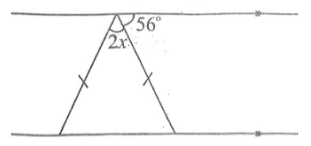
Concept:Use parallel line alternate angles, the isosceles triangle property, and the angle-sum rule for triangles.Explanation:In the diagram, AB∥DE, and BD is a transversal. Therefore, alternate angles are equal:∠ABD=∠BDE.Since ∣BD∣=∣BE∣, △BDE is isosceles, so the base angles are equal:∠BDE=∠BED.The angles on the straight line at B add up to 180∘:∠ABD+2x+56∘=180∘.So,∠ABD=180∘−56∘−2x=124∘−2x.Thus, each base angle of △BDE is also 124∘−2x.Now apply the angle sum of a triangle to △BDE:2x+(124∘−2x)+(124∘−2x)=180∘.Simplify:248∘−2x=180∘.Therefore,2x=68∘.x=34∘.Answer:x=34∘, so the correct option is C.