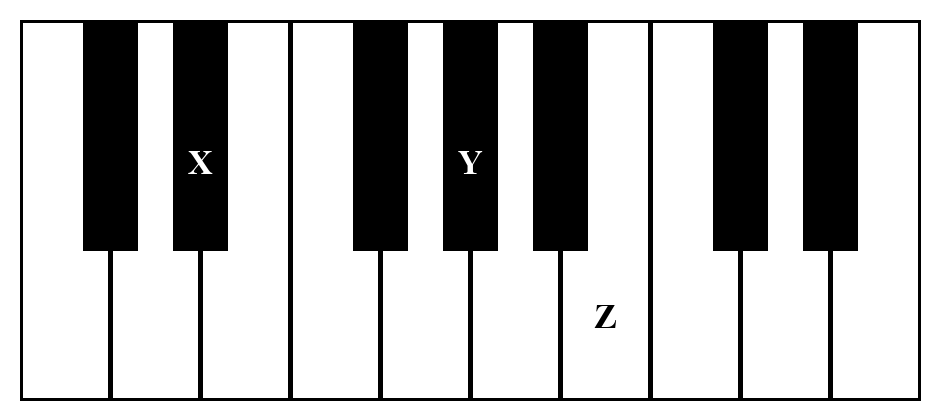
Concept:Black keys come in groups of two and three. The white key just left of the group of two is C; the white key just left of the group of three is F. A black key is named as a sharp of the white key on its left or a flat of the white key on its right.
Solution:Start at the left: the first group has two black keys, so the white keys there are C, D, E.
X is the second black key of the group of two: between D and E, so it is D-sharp =
E-flat.
Y is the middle black key of the group of three (F#, G#, A#): between G and A, so it is G-sharp =
A-flat.
Z is the white key after the group of three, just before the next C:
B.
Only option B (E-flat, A-flat, B) gives all three correctly.
Key point: Option C names X correctly (D-sharp) but Y wrongly (F-sharp is the first black key of the three) and Z wrongly.
Answer:Option B (E-flat, A-flat, B)