Paper question 1
Concept:Sodium chloride (common salt) dissolves in water to form a homogeneous mixture (a solution). To get the salt back, the water is driven off by heating: the water leaves as vapour and the salt is left behind as crystals.
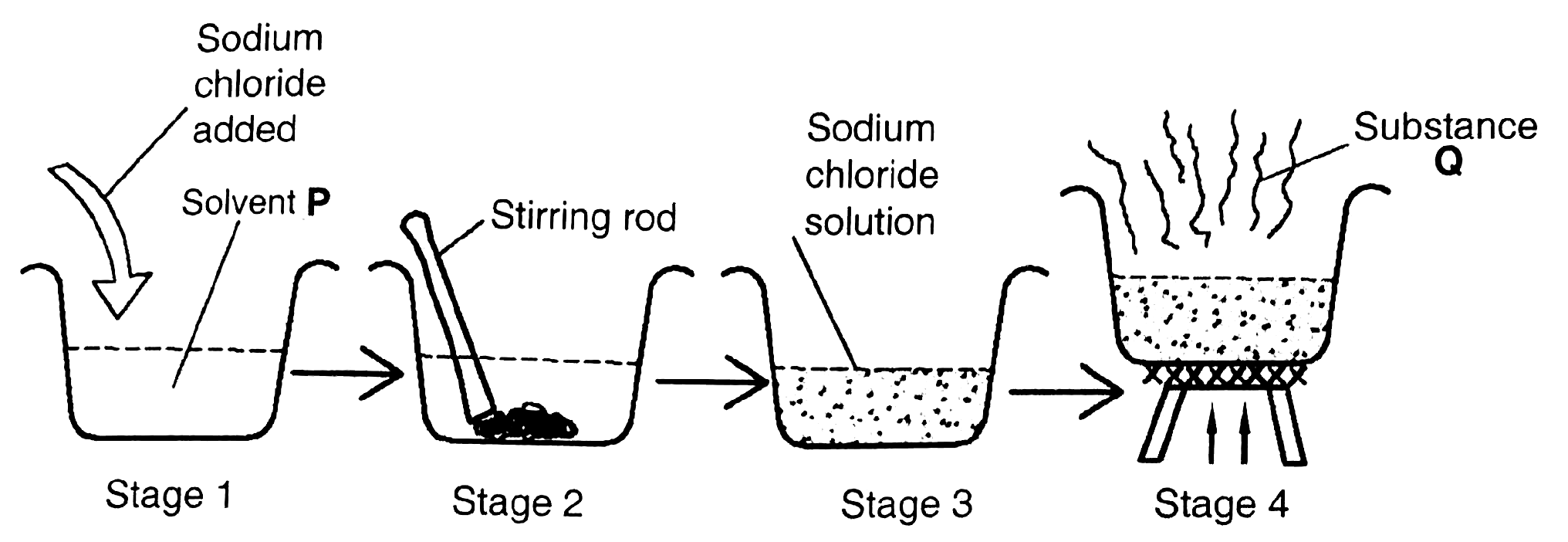
(a)(i) (1 mark)Water (distilled water).
Water is the solvent that dissolves common salt.
(a)(ii) (2 marks)1. The sodium chloride crystals dissolve (they get smaller and disappear) as the mixture is stirred.
2. A clear, colourless solution forms (some crystals that do not dissolve remain at the bottom of the beaker).
Salt is soluble in water, so the crystals break up into the water and cannot be seen; the solution stays colourless because salt is white.
(a)(iii) (1 mark)Water vapour (steam).
On heating, the water (solvent) evaporates and rises from the dish as vapour; the salt does not.
(b) (1 mark)To make the sodium chloride dissolve faster (stirring spreads the salt through the water and brings fresh water into contact with the crystals).
(c) (1 mark)Filtration (decanting is also accepted).
The filter paper lets the solution through and holds back the undissolved crystals.
(d)(i) (2 marks)The solution was
heated in an evaporating dish over a flame. The water
evaporated and escaped as vapour (substance Q), leaving sodium chloride crystals in the dish.
(d)(ii) (1 mark)Evaporation.
Heating a solution until the solvent goes off as vapour and the dissolved solid is left behind is evaporation.
(d)(iii) (1 mark)Any one, e.g.:
- Wear safety goggles, because hot salt can spit out of the dish near the end.
- Do not touch the hot evaporating dish with bare hands; use tongs.
- Do not taste any substance in the laboratory.
- Keep the face away from the dish while heating.