Paper question 3
Concept:Weight is the pull of gravity on a mass:
W=mg. Pressure is force per unit area:
P=AF. For the same force, the smallest area gives the largest pressure.
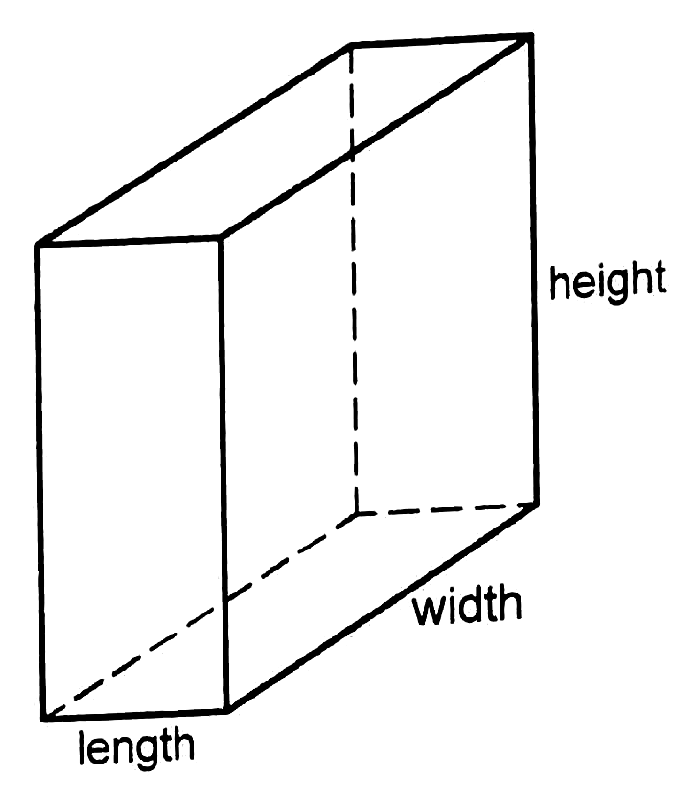
(a) (3 marks)Measured on the printed paper (to the nearest 0.1 cm):
(i) length
=1.5 cm
(ii) width
=3.0 cm
(iii) height
=4.0 cm
Place the zero mark of the ruler at one end of each edge and read the other end at eye level.
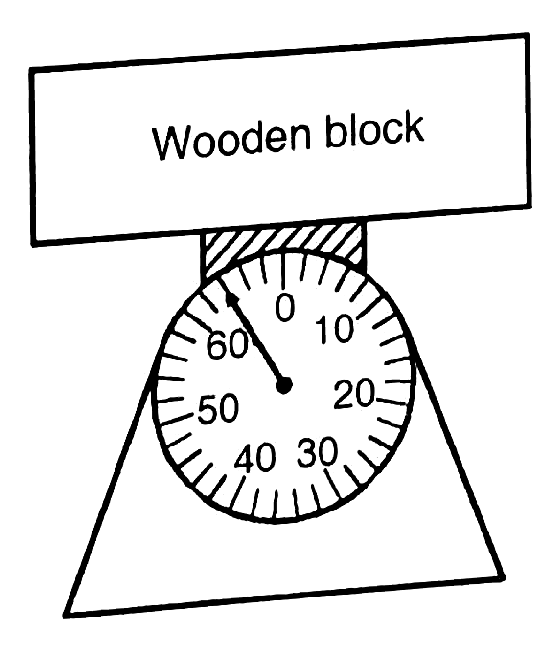
(b)(i) (1 mark)Mass
=64 g.
The dial is marked every 10 g with 5 small divisions between numbers, so each division is
510=2 g. The pointer is 2 divisions past 60:
60+2×2=64 g.
(b)(ii) (1 mark)1 kg=1000 g, so
64 g=100064=0.064 kg(c) (2 marks)W=m×g=0.064 kg×10 N/kg=0.64 N(d) (3 marks)The force on the surface is the weight of the block,
F=0.64 N.
Pressure is greatest when the block stands on its smallest face (length × width, as in the diagram):
A=1.5 cm×3.0 cm=4.5 cm2In square metres:
4.5 cm2=100004.5 m2=0.00045 m2P=AF=0.00045 m20.64 N≈1422 N/m2 (Pa)
(In N/cm²:
4.50.64≈0.142 N/cm2.)
Key point: "Maximum pressure" means the smallest area. The other faces (1.5 cm × 4.0 cm = 6 cm² and 3.0 cm × 4.0 cm = 12 cm²) give smaller pressures.