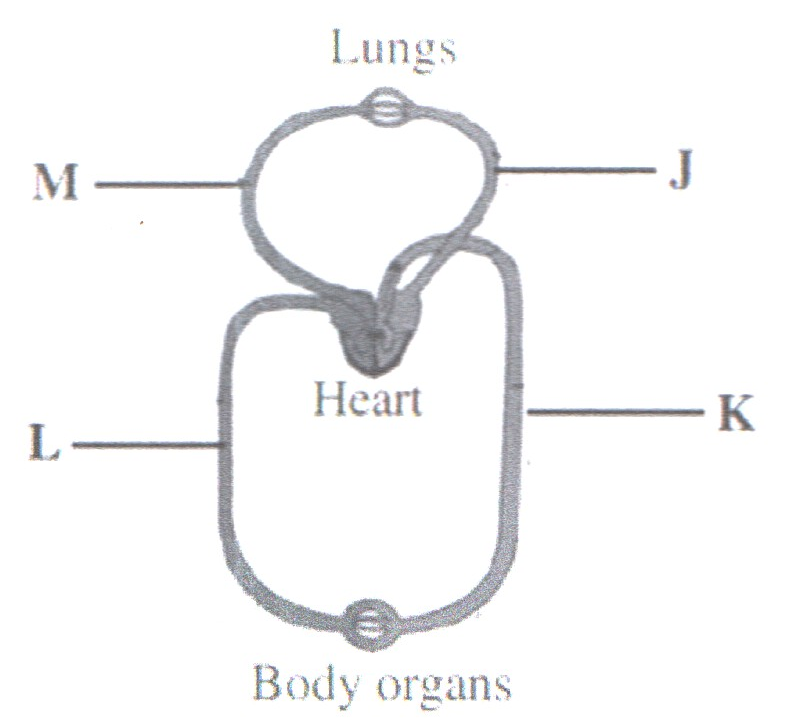
Concept:Blood picks up oxygen in the lungs. Oxygen-rich blood goes back to the heart (left side) and the heart pumps it out to the body. Blood that has given its oxygen to the body organs comes back to the right side of the heart and is sent to the lungs.
Solution:In the diagram the vessels on the right of the picture,
J and
K, join the same side of the heart, and the vessels on the left of the picture,
M and
L, join the other side.
Heart diagrams are drawn as if we face the person, so the right of the picture is the person's
left side of the heart, the side that carries oxygen-rich blood. The curved vessel at the top right is the big artery (aorta) leaving that side.
J: from the lungs to the heart, carrying fresh oxygen.
K: from the heart to the body organs, carrying oxygen.
M (heart to lungs) and
L (body back to heart) carry blood that has lost its oxygen.
So J and K carry blood with oxygen.
Key point: L and M (option B) is the trap: those two vessels carry blood
without oxygen. Options C and D mix one vessel from each side, so they cannot both carry oxygen-rich blood.
Answer:Option A (
J and
K)