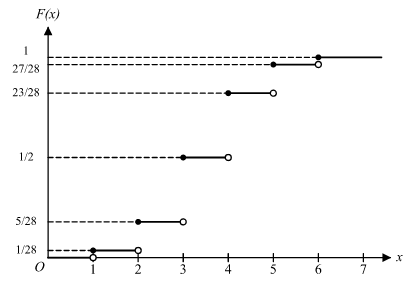
What we are solvingX takes the values 1 to 6 with P(X=x)=kx2 for 1, 2, 3 and k(7−x)2 for 4, 5, 6Find k, the mean, the variance, the cumulative distribution F(x) and sketch F(x)Chapter: Probability distributionsTopic: discrete random variablesConcept and formulas∑P(X=x)=1E(X)=∑xP(X=x),Var(X)=E(X2)−[E(X)]2F(x)=P(X≤x)(a)(9 marks)(i) The probabilities
x
1
2
3
4
5
6
P(X=x)
k
4k
9k
9k
4k
k
28k=1⇒k=281(ii) MeanE(X)=281(1+8+27+36+20+6)=2898=3.5(The distribution is symmetric about 3.5, which confirms it)(iii) VarianceE(X2)=281(1+16+81+144+100+36)=28378=13.5Var(X)=13.5−3.52=13.5−12.25=1.25(b)(3 marks)(i) Add the probabilities step by stepF(x)=⎩⎨⎧0,281,285,21,2823,2827,1,x<11≤x<22≤x<33≤x<44≤x<55≤x<6x≥6(ii) F(x) is a step graph: each step starts with a filled dot and ends with an open dot
Answer: (a) k = 1/28, E(X) = 3.5, Var(X) = 1.25 (b) F(x) as above, a rising step graph from 0 to 1Tip: The last value of F(x) must be 1; that checks k