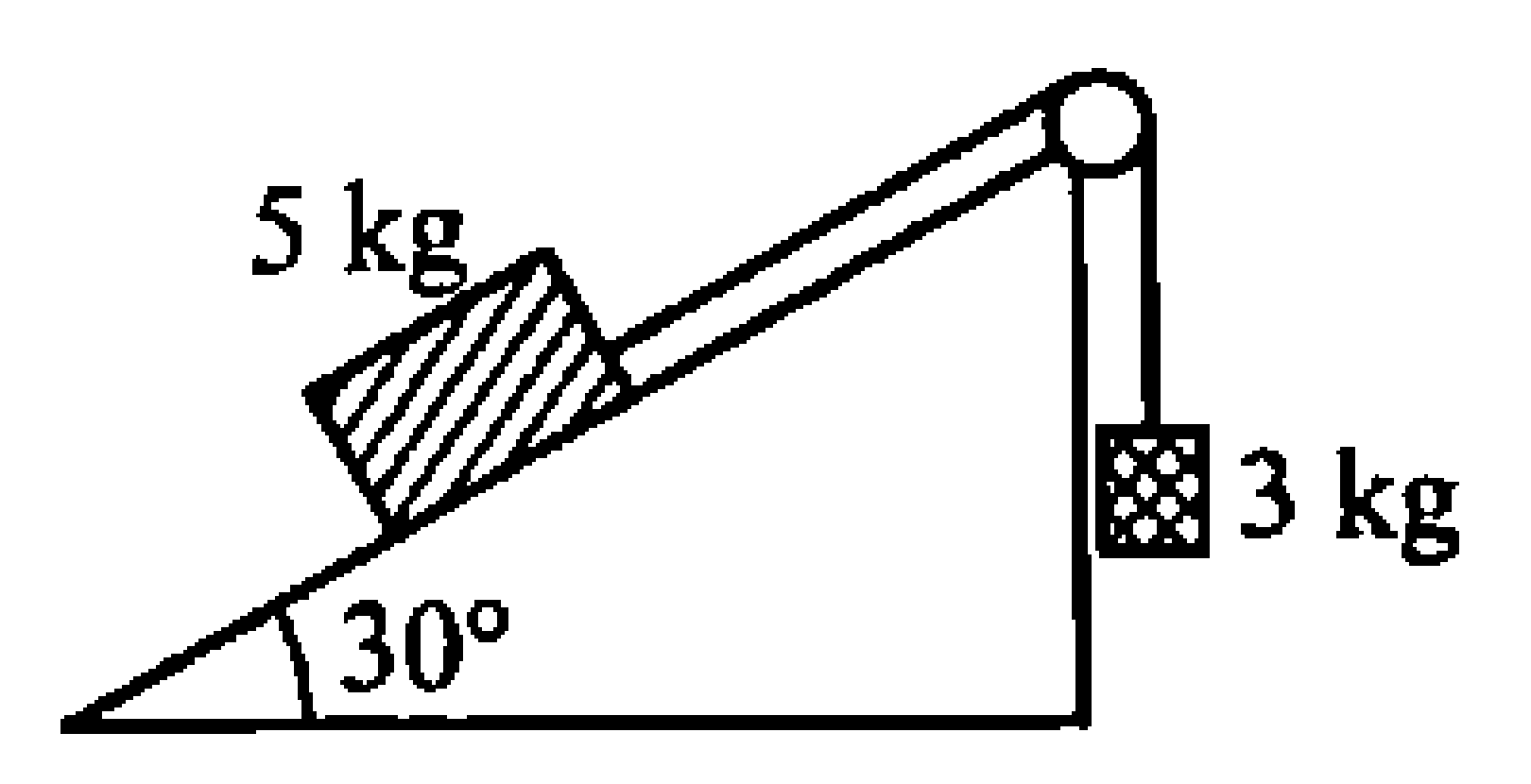
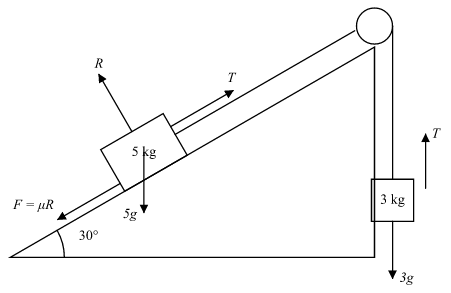
What we are solvingA 5 kg mass rests on a rough plane inclined at 30°A string over a smooth pulley holds a freely hanging 3 kg massThe system is in limiting equilibrium; find the coefficient of friction μChapter: Mechanics (statics)Topic: limiting friction, connected particlesConcept and formulasThe 3 kg mass is at rest, so the tension equals its weightT=3gLimiting friction on the 5 kg massF=μR,R=5gcos30∘Friction acts against the way the mass tends to moveWorking: which way does friction act?T=3g=3×9.8=29.4N5gsin30∘=5×9.8×0.5=24.5NThe pull of the string (29.4 N) is greater than the weight component down the slope (24.5 N)So the 5 kg mass tends to move up the slope, and friction acts down the slope
Working: resolvingPerpendicular to the planeR=5gcos30∘=5×9.8×0.8660=42.44NAlong the plane (limiting equilibrium)T=5gsin30∘+μR29.4=24.5+42.44μμ=42.444.9=531=0.115Key point: With friction taken up the slope the equation gives μR = 24.5 − 29.4, a negative value, which is impossible. With these masses the tension is not just preventing a slide down; it holds the mass on the point of moving up the slope, so friction acts down the slopeAnswer: μ = 1/(5√3) ≈ 0.115Tip: Always compare the tension with mg sin θ first to fix the direction of friction