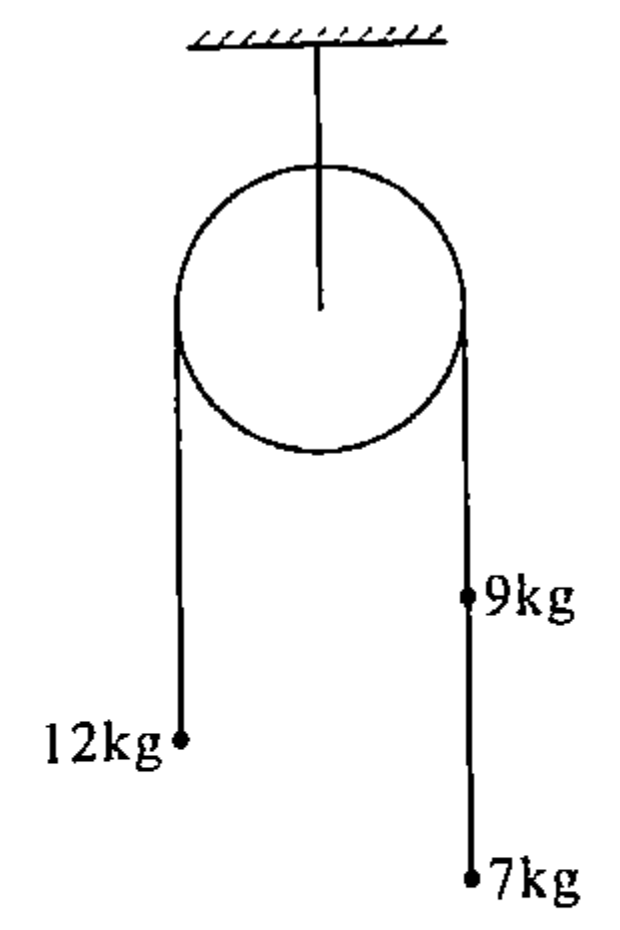
What we are solving12 kg hangs on one side of a smooth fixed pulley
9 kg hangs on the other side, with 7 kg hanging below it on a second string
Released from rest, the 12 kg mass rises
Find the acceleration, the two tensions, and the speed of the 12 kg mass after 1.5 s
Chapter: Mechanics (dynamics)
Topic: connected particles, pulleys, Newton's second law
Concept and formulasThe strings are light and inelastic, so all three masses have the same size of acceleration a
The pulley is smooth, so the tension T₁ is the same on both sides of it; T₂ is the tension in the lower string
For each mass: resultant force in the direction of motion = mass × acceleration,
F=maThen
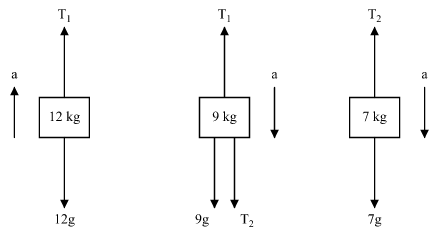
v=u+at(a)(i)Forces on each mass
12 kg (moves up)
T1−12g=12a(1)9 kg (moves down)
9g+T2−T1=9a(2)7 kg (moves down)
7g−T2=7a(3)Add (1), (2) and (3): the tensions cancel
16g−12g=28a ⇒ a=284×9.8=1.4 ms−2(a)(ii) (10 marks for (a))From (1)
T1=12(9.8+1.4)=134.4 NFrom (3)
T2=7(9.8−1.4)=58.8 NCheck with (2):
9(9.8)+58.8−134.4=12.6=9(1.4) ✓
(b) (2 marks)v=u+at=0+1.4×1.5=2.1 ms−1The 12 kg mass moves upwards at 2.1 m/s
Answer: (a)(i) a = 1.4 m/s² (ii) T₁ = 134.4 N (string over the pulley), T₂ = 58.8 N (string between 9 kg and 7 kg) (b) 2.1 m/s upwards
Tip: Adding the three equations removes both tensions and gives a directly