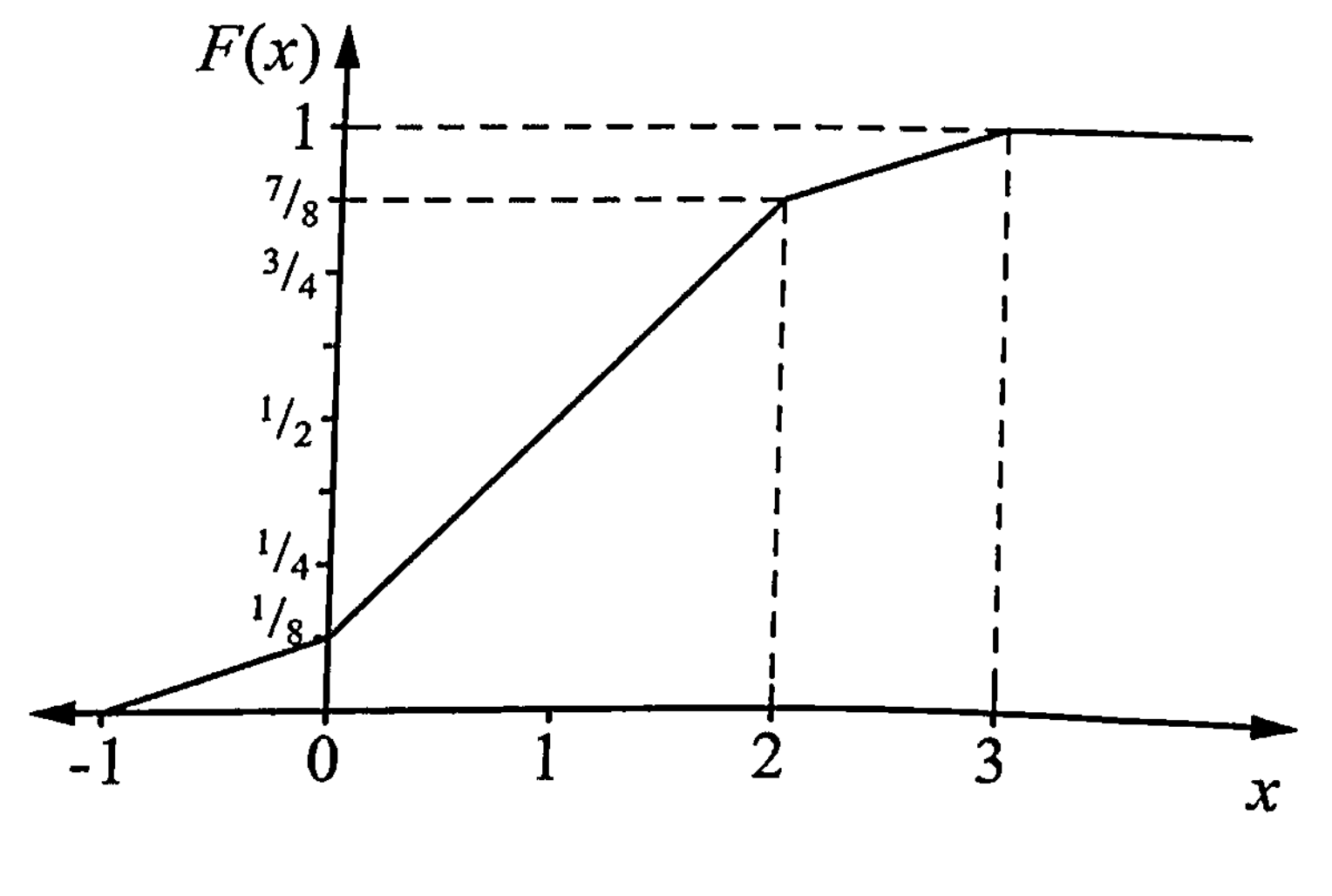
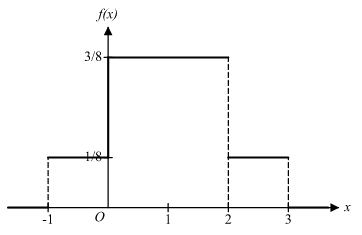
What we are solvingThe graph of the cumulative distribution F(x) is made of straight piecesPoints read from it: (−1,0), (0,81), (2,87), (3,1)(a) Write F(x) and find P(1<X<2.5) (b) Find the pdf and the meanChapter: ProbabilityTopic: continuous random variables, cdf and pdfConcept and formulasEach straight piece: y=mx+c, with gradientm=x2−x1y2−y1P(a<X<b)=F(b)−F(a)The pdf is the gradient of the cdff(x)=dxdFE(X)=∫xf(x)dx(a)(i)(5 marks)From (−1,0) to (0,81): gradient 81F(x)=81(x+1)From (0,81) to (2,87): gradient 23/4=83F(x)=81+83x=81(3x+1)From (2,87) to (3,1): gradient 81F(x)=87+81(x−2)=81(x+5)SoF(x)=⎩⎨⎧0,81(x+1),81(3x+1),81(x+5),1,x<−1−1≤x<00≤x<22≤x<3x≥3(a)(ii)(2 marks)F(2.5)=81(2.5+5)=87.5F(1)=81(3+1)=84P(1<X<2.5)=87.5−4=167=0.4375(b)(i)(2 marks)Differentiate each piecef(x)=⎩⎨⎧81,83,81,0,−1≤x≤00≤x≤22≤x≤3elsewhere
Check: area =81(1)+83(2)+81(1)=1(b)(ii)(3 marks)E(X)=∫−1081xdx+∫0283xdx+∫2381xdx=81[2x2]−10+83[2x2]02+81[2x2]23=−161+43+165=16−1+12+5=1Answer: (a)(ii) 167=0.4375 (b)(ii) E(X)=1; F(x) and f(x) as aboveTip: A straight-line cdf gives a constant pdf on that interval: the gradient