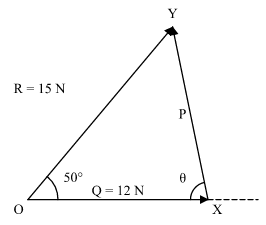
What we are solvingTwo forces P and Q add up to a resultant RR=15 N at 50∘ to Q, and Q=12 NWe need the size of P and its directionChapter: Mechanics (statics)Topic: resultant of two forces, triangle of forcesConcept and formulasThe forces form a triangle: Q followed by P gives RSo P=R−QCosine rule in that triangleP2=R2+Q2−2RQcos50∘Sine rule to find the angleRsinθ=Psin50∘θ is the angle between P and the line of Q, inside the triangleWorkingDraw Q along OX, R along OY at 50∘ to Q; P closes the triangle (XY)
Size of PP2=152+122−2(15)(12)cos50∘P2=225+144−360(0.6428)=369−231.40=137.60P=137.60=11.73 NAngle at X in the trianglesinθ=11.7315sin50∘=11.7311.491=0.9796θ is opposite R, and R2=225<P2+Q2=281.6, so θ is acuteθ=78.40∘P acts along XY, so the angle between P and the direction of Q is180∘−78.40∘=101.60∘Check with components (Q along the x-axis)P=(15cos50∘−12)i+15sin50∘j=−2.358i+11.491j∣P∣=2.3582+11.4912=11.73 NAnswer:P=11.73 N, acting at 101.6∘ to force Q (that is, 51.6∘ to the resultant)Tip: Always sketch the triangle of forces first; it tells you which angle the cosine rule needs