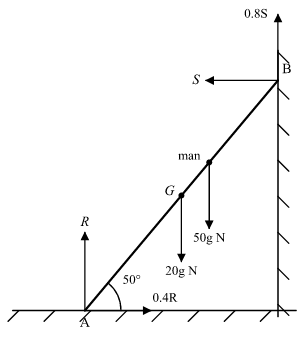
What we are solvingUniform ladder AB, 20 kg, 5 m, at 50∘ to the ground; foot A on rough ground (μ=0.4), top B on rough wall (μ=0.8)A man of 50 kg climbs it. Find the reactions at A and B when slipping is about to happen, and how far up he can goChapter: StaticsTopic: friction and equilibrium of a rigid body (ladder problems)Concept and formulasWhen the ladder is about to slip, friction is limiting at both ends: F=μRThe foot tends to slide away from the wall, so friction at A acts towards the wallThe top tends to slide down, so friction at B acts upwardsEquilibrium: forces balance horizontally and vertically, and moments about any point are zero
R = normal reaction at A, S = normal reaction at B, d = distance of the man from A along the ladder(a)(8 marks)Resolve horizontallyS=0.4R(1)Resolve verticallyR+0.8S=20g+50g=70×9.8=686(2)Put (1) into (2)R+0.8(0.4R)=686⇒1.32R=686R=519.7NS=0.4×519.7=207.9NFriction forces: 0.4R=207.9 N at A and 0.8S=166.3 N at BResultant reactionsat A:519.72+207.92=559.7Nat B:207.92+166.32=266.2N(b)(4 marks)Take moments about A (clockwise = anticlockwise)S(5sin50∘)+0.8S(5cos50∘)=20g(2.5cos50∘)+50g(dcos50∘)207.9(3.8302)+166.3(3.2139)=196(1.6070)+490(0.6428)d796.2+534.5=315.0+315.0d1330.7−315.0=315.0dd=315.01015.7=3.22mAnswer: (a) normal reactions R=519.7 N at A, S=207.9 N at B (resultants 559.7 N and 266.2 N) (b) 3.22 m up the ladderTip: Moments about the foot A remove both unknown forces there