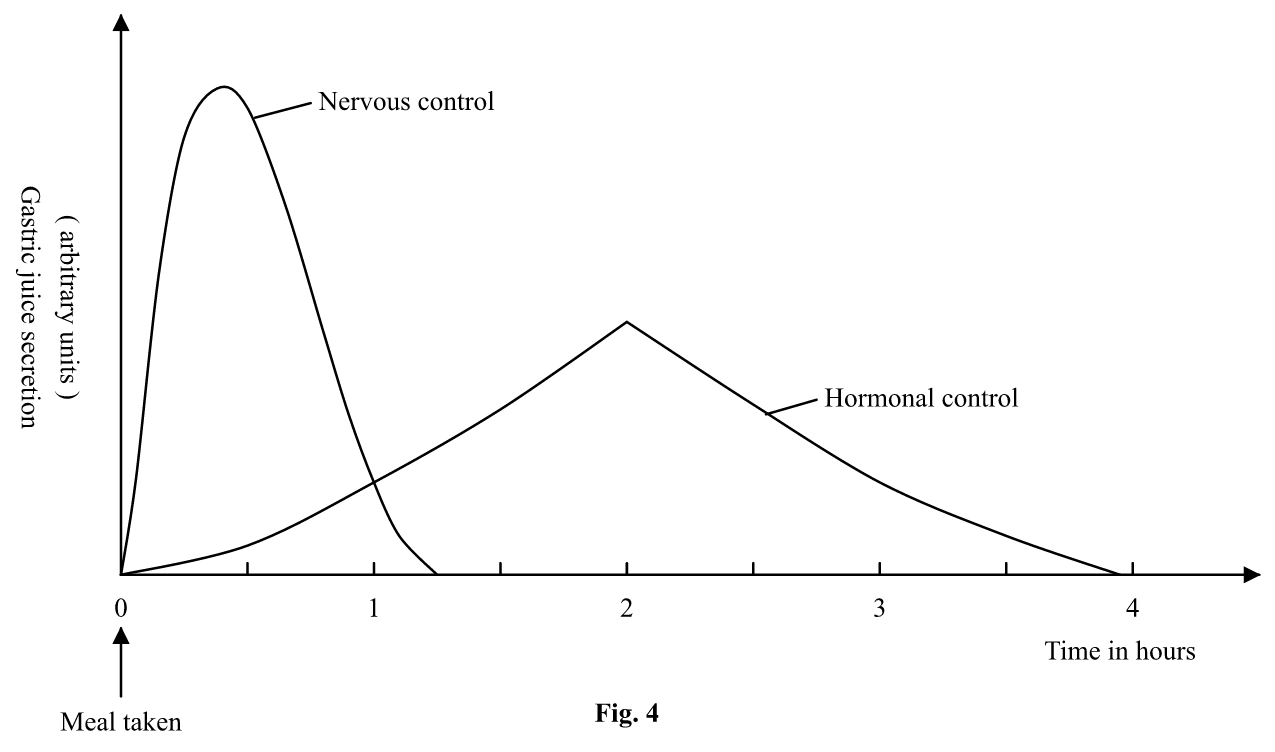
What we are solvingFig. 4: gastric juice secretion against time after a meal, under nervous and under hormonal control
(a) Comment on nervous control
(b)(i) Differences between the two controls
(b)(ii) Reasons for the differences
Chapter: Nutrition / Coordination
Topic: Control of gastric secretion
(a) (03 marks)Secretion starts at once when the meal is taken (time 0) and rises very fast
It reaches a high peak at about 0.4 h (24 minutes)
It then falls quickly and stops at about 1.25 h: a rapid, large but short response
(b)(i) (03 marks)Nervous control starts at once; hormonal control starts slowly and rises gradually
Nervous control reaches a higher peak (about 0.4 h); hormonal control has a lower peak, later at 2 h
Nervous control stops after about 1.25 h; hormonal control lasts longer, to about 4 h
(b)(ii) (04 marks)Nervous (cephalic) phase: sight, smell, taste and chewing of food send impulses along the vagus nerve to the gastric glands, so secretion begins at once
Nerve impulses travel very fast, so the response is rapid and large
The reflex stops when the food stimuli end (swallowing ends), so the nervous effect is short
Hormonal (gastric) phase: food in the stomach stimulates G-cells to release gastrin into the blood
Gastrin must travel in the blood to the gastric glands, so the response is slow to start
Gastrin is released as long as food (protein) remains in the stomach and is broken down slowly, so secretion lasts about 4 h
Answer: (a) immediate, rapid rise, high peak at about 0.4 h, ends about 1.25 h; (b)(i) nervous fast/high/short, hormonal slow/lower/long; (b)(ii) vagus reflex versus gastrin carried in blood