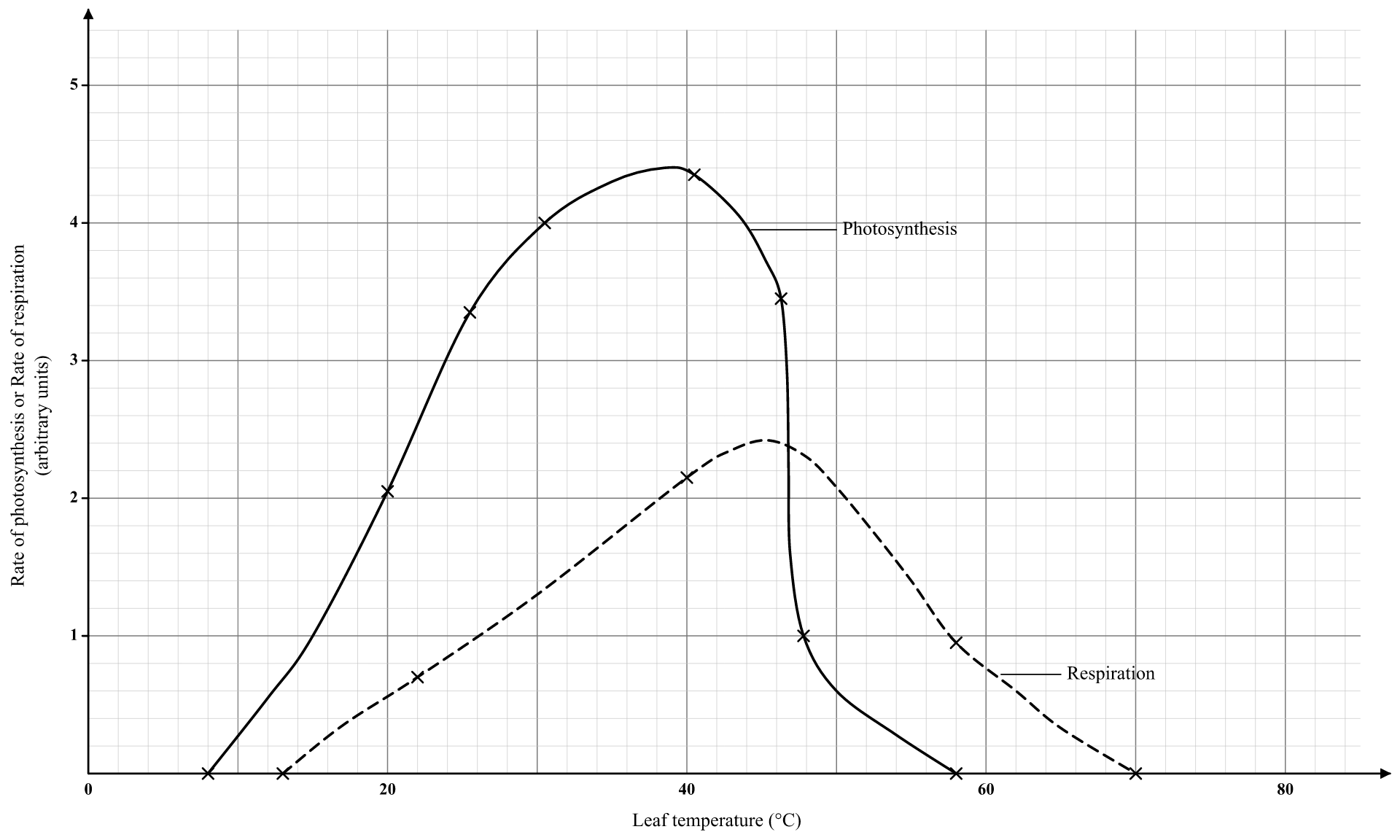
What we are solvingFig. 1: rate of photosynthesis and of respiration in leaves of one plant at leaf temperatures 0 to 80
∘C (light adequate)
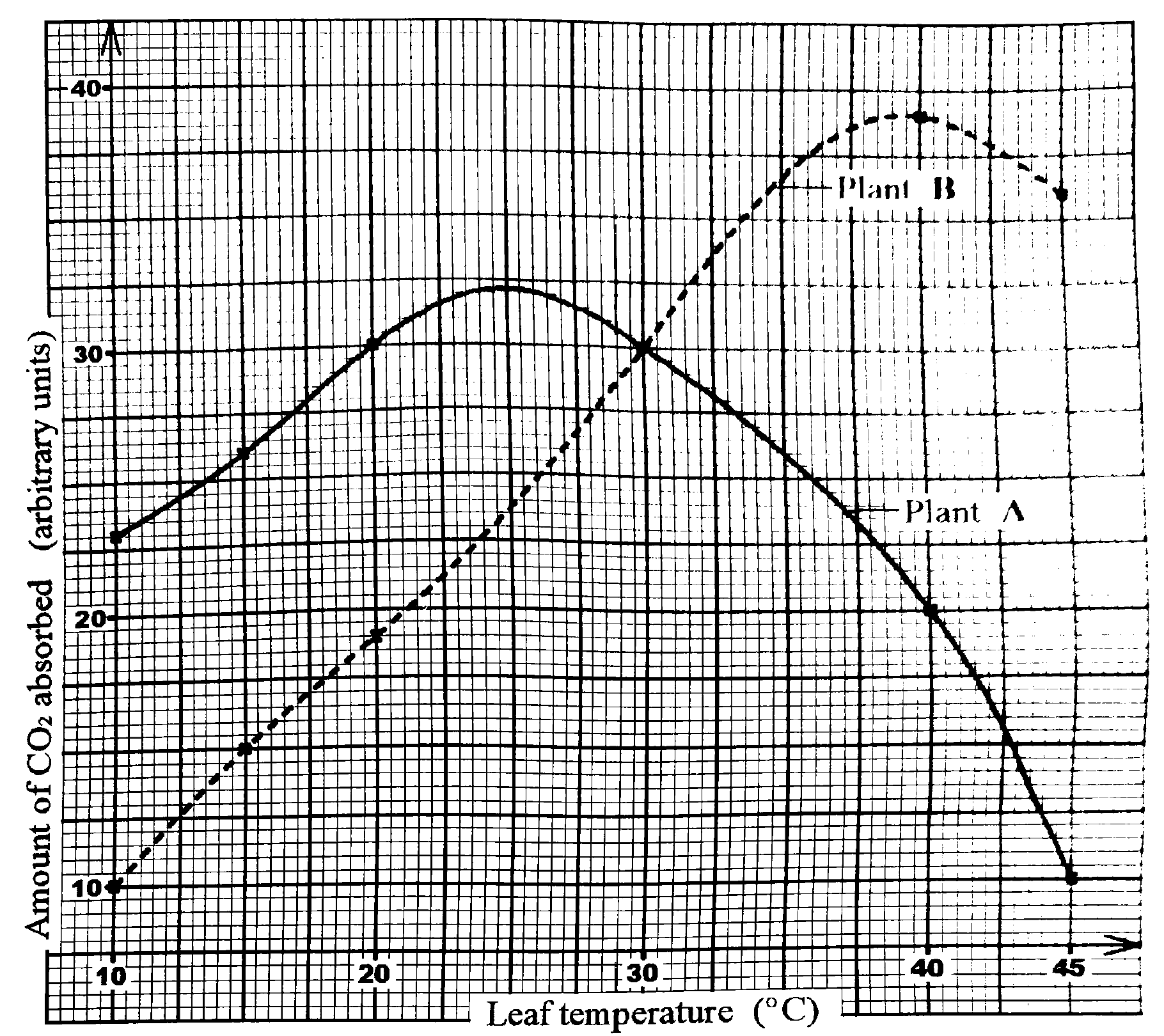
Fig. 2: amount of
CO2 absorbed by plants A and B (different
CO2 fixation pathways) at 10 to 45
∘C
We must read and explain both graphs, identify the plant of Fig. 1, and explain other limiting factors and
C4 fixation
Readings from the graphs (arbitrary units):
Fig. 1 photosynthesis: 0 at 8
∘C, 2.0 at 20
∘C, 4.0 at 30
∘C, peak about 4.4 at 38 to 40
∘C, 3.5 at 46
∘C, 1.0 at 48
∘C, 0 at 58
∘C
Fig. 1 respiration: 0 at 13
∘C, 0.7 at 22
∘C, 2.2 at 40
∘C, peak about 2.4 at 45
∘C, 1.0 at 58
∘C, 0 at 70
∘C
Fig. 2 plant A: 23 at 10
∘C, 30 at 20
∘C, peak about 33 at 25
∘C, 30 at 30
∘C, 20 at 40
∘C, 10 at 45
∘C
Fig. 2 plant B: 10 at 10
∘C, 19 at 20
∘C, 30 at 30
∘C, peak about 39 at 40
∘C, 36 at 45
∘C
Chapter: Photosynthesis; Respiration
Topic: effect of temperature on photosynthesis and respiration;
C3 and
C4 plants; limiting factors
Concept and formulasBoth photosynthesis and respiration are chains of enzyme-controlled reactions
Rise in temperature raises the kinetic energy of enzyme and substrate molecules: more collisions, more enzyme-substrate complexes, faster rate (up to the optimum)
Above the optimum, hydrogen and ionic bonds of the enzymes break, the active site changes shape (denaturation) and the rate falls
Overall photosynthesis:
6CO2+6H2O→C6H12O6+6O2Aerobic respiration:
C6H12O6+6O2→6CO2+6H2O+energy (ATP)C3 plants fix
CO2 only with Rubisco; at high temperature Rubisco binds more
O2 (photorespiration), so net
CO2 uptake falls
C4 plants first fix
CO2 with PEP carboxylase (no affinity for
O2) and concentrate it in the bundle sheath, so they work best at high temperature and light
(a)(i) (4 marks)No photosynthesis below about 8
∘C
From 8
∘C to about 15
∘C the rate increases gradually (0 to 1.0)
From 15
∘C to 30
∘C the rate increases rapidly (1.0 to 4.0)
From 30
∘C to about 39
∘C it increases gradually to a maximum of about 4.4 units (optimum temperature about 38 to 40
∘C)
From 40
∘C to 46
∘C it decreases gradually (4.4 to 3.5)
From 46
∘C to 48
∘C it decreases very rapidly (3.5 to 1.0)
From 48
∘C to 58
∘C it decreases gradually to zero; no photosynthesis above 58
∘C
(a)(ii) (5 marks)Description: no respiration below about 13
∘C; the rate increases gradually and steadily from 13
∘C to a maximum of about 2.4 units at about 45
∘C; it then decreases gradually to 1.0 at 58
∘C and to zero at 70
∘C
Explanation:
Below 13
∘C the respiratory enzymes have too little kinetic energy to form enzyme-substrate complexes, so they are inactive
From 13
∘C to 45
∘C the rising temperature increases the kinetic energy of the enzymes (of glycolysis, Krebs cycle and the electron transport chain) and of substrate molecules
More frequent collisions form more enzyme-substrate complexes, so respiration speeds up
About 45
∘C is the optimum temperature for the respiratory enzymes
Above 45
∘C the hydrogen and ionic bonds holding the enzymes' tertiary structure break; the active sites lose their shape (denaturation), so fewer complexes form and the rate falls
Membranes of the mitochondria are also damaged, disturbing the electron transport chain
At 70
∘C all the respiratory enzymes are denatured (cells die), so respiration stops
(a)(iii) (8 marks)Difference: from 40
∘C to about 47
∘C photosynthesis is higher than respiration; at about 47
∘C the two rates are equal; above 47
∘C respiration is higher than photosynthesis
Photosynthesis falls sharply and stops at 58
∘C, but respiration falls gradually and continues up to 70
∘C
Explanation:
The photosynthetic enzymes (Rubisco and other Calvin cycle enzymes) are less heat stable than respiratory enzymes, so they are denatured at a lower temperature
High temperature damages the thylakoid membranes and degrades chlorophyll, so the light-dependent stage (photolysis, ATP and NADPH formation) stops
At high temperature the leaf loses much water and the stomata close, cutting off the
CO2 supply for the Calvin cycle
At high temperature Rubisco fixes more
O2 than
CO2 (photorespiration), which lowers net photosynthesis
Respiratory enzymes are more heat stable, so respiration continues at higher temperatures but falls gradually as they are progressively denatured
Respiration still has substrate (sugars and starch stored earlier) even after photosynthesis has stopped
Between 58
∘C and 70
∘C only respiration occurs, so the leaf uses up its food reserves (net loss of dry mass)
Above 70
∘C all enzymes are denatured, so both processes stop
(a)(iv) (4 marks)The products of photosynthesis (glucose and oxygen) are the raw materials of aerobic respiration
The products of respiration (
CO2 and water) are raw materials of photosynthesis
Respiration provides ATP for growth, active uptake of minerals and synthesis of chlorophyll and enzymes used in photosynthesis, especially in the dark and in non-green cells
Both use electron transport chains and make ATP by chemiosmosis (in chloroplasts and mitochondria); both are enzyme controlled, so both are affected by temperature
The plant gains dry mass only when photosynthesis is faster than respiration; where the two rates are equal (compensation point, about 47
∘C in Fig. 1) there is no net gain
(b) (7 marks)Similarities:
In both,
CO2 absorption increases with temperature up to an optimum, then decreases
Both absorb the same amount (30 units) at 30
∘C
Differences:
From 10
∘C to 30
∘C plant A absorbs more
CO2 than plant B (e.g. 23 against 10 units at 10
∘C)
From 30
∘C to 45
∘C plant B absorbs more than plant A (e.g. 36 against 10 units at 45
∘C)
Plant A increases gradually, while plant B increases rapidly and almost steadily
Plant A has a lower optimum (about 25
∘C) than plant B (about 40
∘C)
Plant A's maximum (about 33 units) is lower than plant B's (about 39 units)
After the optimum, plant A decreases rapidly (to 10 units at 45
∘C), while plant B decreases only slightly (to about 36 units)
(c) (4 marks)Plant B
Reasons:
The optimum temperature for photosynthesis in Fig. 1 (about 38 to 40
∘C) is the same as the optimum
CO2 absorption of plant B (about 40
∘C); plant A's optimum is only about 25
∘C
In Fig. 1 the rate of photosynthesis is still high (about 3.5 units) at 45 to 46
∘C, just as plant B still absorbs much
CO2 (36 units) at 45
∘C; plant A's uptake has fallen to 10 units
Both therefore behave like a
C4 plant, adapted to high temperatures
(d) (4 marks)Light intensity: light supplies the energy for photolysis of water and for making ATP and NADPH in the light-dependent stage; as light intensity increases the rate increases until another factor becomes limiting (light saturation); very high intensity can damage (bleach) chlorophyll
Carbon dioxide concentration:
CO2 is the substrate fixed by Rubisco (and PEP carboxylase) in the light-independent stage; raising its concentration increases the rate until another factor limits it; higher
CO2 also reduces photorespiration
(Other factors that may be explained: water supply, which affects photolysis and stomatal opening; mineral ions such as magnesium and nitrogen needed for chlorophyll; chlorophyll content of the leaf)
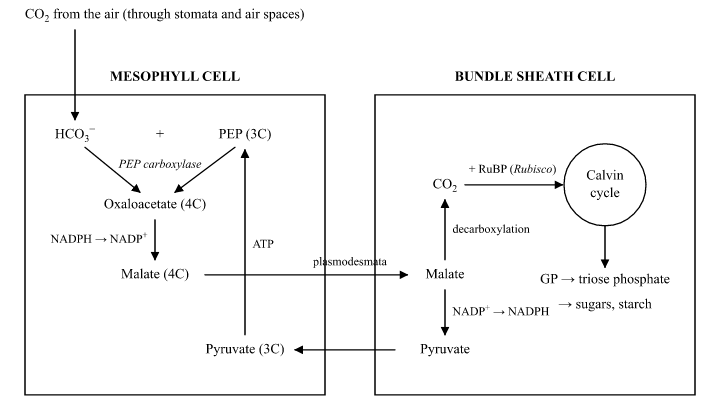
(e) (4 marks)This happens in
C4 plants (e.g. maize, sugarcane, sorghum, elephant grass) with Kranz anatomy
Atmospheric
CO2 diffuses through the stomata into the mesophyll cells, where it is present as hydrogen carbonate ions (
HCO3−)
In the mesophyll, PEP carboxylase combines it with phosphoenolpyruvate (PEP, 3C) to form oxaloacetate (4C)
Oxaloacetate is reduced by NADPH to malate (4C) (or changed to aspartate)
Malate passes through plasmodesmata into the bundle sheath cells
In the bundle sheath cells malate is decarboxylated: it releases
CO2 and pyruvate (3C), and NADPH is formed
The released
CO2 (now at high concentration) is fixed by Rubisco with ribulose bisphosphate (RuBP, 5C) to form two molecules of glycerate 3-phosphate (GP), which enter the Calvin cycle to make triose phosphate, sugars and starch
Pyruvate returns to the mesophyll and is converted back to PEP using ATP
Answer: (a)(i) slow rise from 8
∘C, rapid rise to 30
∘C, optimum about 40
∘C (4.4 units), sharp fall at 46 to 48
∘C, zero at 58
∘C; (ii) gradual rise from 13
∘C to optimum about 45
∘C, then gradual fall to zero at 70
∘C (enzyme kinetics then denaturation); (iii) photosynthetic enzymes are less heat stable, stomata close and photorespiration rises, so photosynthesis falls below respiration above about 47
∘C; (iv) the products of one are the raw materials of the other; (b) A higher below 30
∘C, B higher above, equal at 30
∘C; (c) plant B (
C4); (d) light intensity,
CO2 concentration; (e) PEP carboxylase, then malate carries
CO2 to the bundle sheath, where Rubisco refixes it in the Calvin cycle.
Tip: Quote readings with units and temperatures from the graph (e.g. 4.4 units at 40
∘C); description marks need figures, explanation marks need reasons.