Test Index
UACE Biology 2023 Paper 2 (Theory)
© africaexams.com
Question : 3
Total: 6
Solution:
What we are solving(a) Describe the structure of mature xylem and phloem in flowering plants(b) Explain how water taken from the soil keeps a non-woody plant uprightChapter: Transport in plants; Support in plantsTopic: xylem and phloem structure; water uptake and turgor supportConcept and formulasVascular tissue = xylem (water and mineral transport, support) + phloem (translocation of organic food)Turgor: water enters a cell by osmosis, the vacuole swells and presses the cytoplasm against the cell wall (turgor pressure); the wall resists (wall pressure) and the cell becomes firm (turgid)Water moves from a region of higher water potential to a region of lower water potential(a) (10 marks)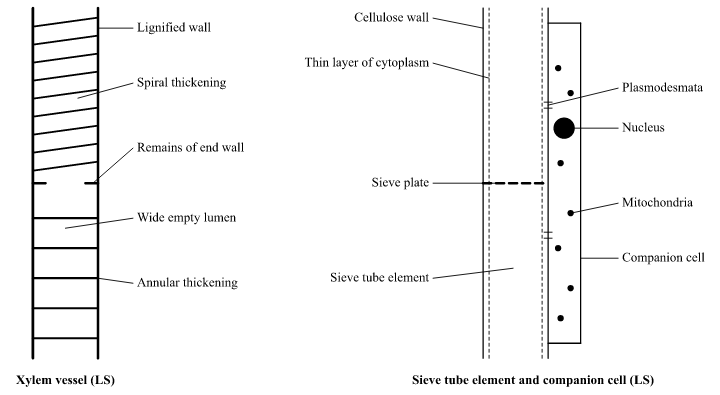 Xylem (made of vessels, tracheids, fibres and parenchyma):Vessel elements: long, wide, dead cells joined end to end; the end walls are broken down, forming a continuous hollow tubeVessels have no cytoplasm or nucleus, so the lumen is emptyTheir walls are thickened with lignin in annular (rings), spiral, reticulate or pitted patternsPits (bordered pits) in the walls allow lateral movement of water between vesselsTracheids: elongated dead cells with tapering, overlapping ends; lignified walls with many pits; narrower lumen than vesselsXylem fibres: long, narrow dead cells with very thick lignified walls and a small lumen (support)Xylem parenchyma: living, thin-walled cells that store food and form raysPhloem (made of sieve tubes, companion cells, parenchyma and fibres):Sieve tube elements: long living cells joined end to end; the end walls are perforated by pores, forming sieve platesMature sieve tube elements have no nucleus, few organelles and a thin layer of cytoplasm lining a cellulose wallCompanion cells: narrow cells beside each sieve element, with dense cytoplasm, a large nucleus and many mitochondria and ribosomesCompanion cells are joined to sieve elements by many plasmodesmataPhloem parenchyma: thin-walled living cells for storage; phloem fibres: lignified sclerenchyma for supportIn a dicot stem the xylem lies on the inside and phloem on the outside of each vascular bundle, with cambium between them(b) (10 marks)Root hairs absorb water from the soil by osmosis, because the soil solution has a higher water potential than the cell sapWater moves across the root cortex to the xylem by the apoplast (cell walls), symplast (cytoplasm) and vacuolar pathways, down a water potential gradientActive pumping of ions into the xylem at the endodermis lowers its water potential and creates root pressure, which pushes water upTranspiration pull from the leaves, with cohesion of water molecules and adhesion to the xylem walls, draws a continuous column of water up the stemFrom the xylem, water enters the living parenchyma and collenchyma cells of the stem, petioles and leaves by osmosisTheir vacuoles swell and push the cytoplasm against the cell walls, building up turgor pressureThe cellulose cell walls resist further stretching (wall pressure), so the cells become turgid and firmTurgid cells press tightly against one another and against the epidermis, making the stem rigid like a hydrostatic skeletonHerbaceous plants have little wood (lignified tissue), so they depend mainly on this turgidity for supportTurgid mesophyll keeps the leaf blades flat and spread out to trap light; turgid guard cells keep the stomata openThe water-filled, lignified xylem vessels themselves also act as strong rods that give supportWhen water loss is greater than uptake, cells become flaccid and the plant wilts: proof that support depends on waterAnswer: (a) xylem: dead, lignified, hollow vessels and tracheids with pits, plus fibres and parenchyma; phloem: living sieve tubes with sieve plates and no nucleus, companion cells with dense cytoplasm, parenchyma and fibres; (b) water enters by osmosis, rises in the xylem and makes cells turgid; turgid cells pressing on each other keep the herbaceous plant rigid.Tip: In (a) describe structure only (shape, wall, contents, ends); function is not asked.
© africaexams.com
Go to Question:
Advertisements