Test Index
UACE Biology 2023 Paper 2 (Theory)
© africaexams.com
Question : 6
Total: 6
Solution:
What we are solving(a) State three features that distinguish gas exchange in fish from that in terrestrial insects(b) Compare gas exchange in bony fish (e.g. tilapia) with cartilaginous fish (e.g. shark)(c) Explain how breathing in man is controlledChapter: Gaseous exchangeTopic: gas exchange in fish and insects; control of ventilation in mammalsConcept and formulasFish exchange gases with water at gills; insects exchange gases with air through a tracheal systemBreathing in man is controlled by the respiratory centre in the medulla oblongata through nervous and chemical (negative feedback) mechanisms(a) (3 marks)
(b) (4 marks)
(c) (13 marks)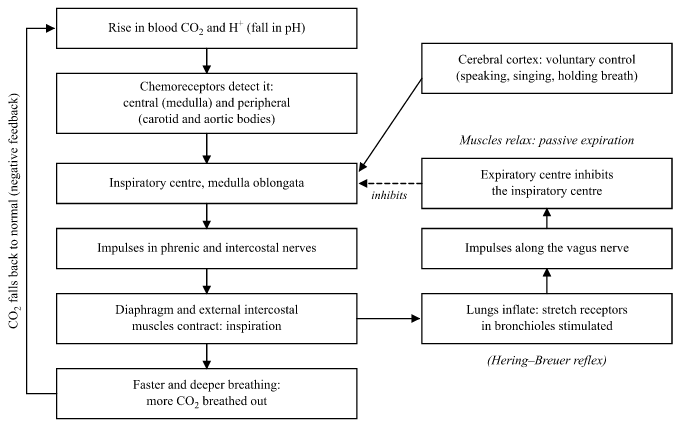 Nervous (rhythmic) control:The respiratory centre is in the medulla oblongata; it has an inspiratory centre and an expiratory centreThe inspiratory centre sends impulses along the phrenic nerves to the diaphragm and along the intercostal nerves to the external intercostal musclesThese muscles contract: the diaphragm flattens and the ribs move up and out; the thoracic volume increases, the pressure falls and air flows in (inspiration)As the lungs inflate, stretch receptors in the walls of the bronchi and bronchioles are stimulatedThey send impulses along the vagus nerve to the expiratory centre, which inhibits the inspiratory centreThe inspiratory muscles relax and the elastic recoil of the lungs drives air out (passive expiration)As the lungs deflate the stretch receptors stop firing, the inspiratory centre becomes active again, and the cycle repeats (Hering-Breuer reflex)Centres in the pons (pneumotaxic centre) also limit inspiration and smooth the rhythmChemical control (negative feedback):A rise in blood CO2 (e.g. during exercise) forms carbonic acid, so the H+ concentration rises and pH falls: CO2+H2O⇌H2CO3⇌H++HCO3−Central chemoreceptors in the medulla detect the fall in pH of the cerebrospinal fluidPeripheral chemoreceptors in the carotid bodies and aortic bodies detect the rise in CO2 and H+ and a large fall in O2; they send impulses along the glossopharyngeal and vagus nervesThe inspiratory centre is stimulated, so the rate and depth of breathing increaseMore CO2 is breathed out; when its level returns to normal the stimulation stops (negative feedback)A fall in blood CO2 (e.g. after over-breathing) slows breathingOther influences:The cerebral cortex gives voluntary control (speaking, singing, holding the breath), but a large rise in CO2 overrides itProprioceptors in working muscles and joints, adrenaline and a rise in body temperature increase breathing during exerciseIrritants in the airways cause the cough and sneeze reflexesAnswer: (a) gills/water/blood transport/one-way flow in fish against tracheoles/air/direct delivery/tidal flow in insects; (b) operculum versus gill slits, countercurrent versus parallel flow, buccal-opercular pump versus ram ventilation; (c) medulla respiratory centre, phrenic and intercostal nerves, stretch receptors and vagus (Hering-Breuer), chemoreceptors sensing CO2/H+ (negative feedback), cortex for voluntary control.Tip: CO2 (through pH), not oxygen, is the main stimulus for breathing in man; say so clearly.
| Fish | Terrestrial insects |
|---|---|
| Respiratory surface is the gills (gill filaments and lamellae) | Respiratory surface is the tracheoles of a tracheal system |
| Exchange medium is water | Exchange medium is air |
| Gases are carried between gills and tissues by blood (haemoglobin) | Gases reach the tissues directly through tracheoles; blood plays no part |
| Water flows one way over the gills (in at the mouth, out at the gill openings) | Air moves in and out (tidal) through spiracles |
| Ventilation by the buccal cavity and operculum or gill slits | Ventilation by abdominal pumping movements |
| Bony fish | Cartilaginous fish |
|---|---|
| Gills covered by an operculum; one gill opening on each side | No operculum; 5 to 7 separate gill slits on each side |
| Countercurrent flow: water and blood flow in opposite directions, so about 80% of the oxygen is extracted | Mainly parallel flow, so less oxygen (about 50%) is extracted |
| Continuous ventilation by the buccal pump and the opercular suction pump, even when still | Ventilation by the mouth and pharynx pump; many must keep swimming (ram ventilation) |
| Gill septum short; gill filaments free at their tips | Long gill septum reaching the skin as a flap over each slit |
| No spiracle | Water also enters through a spiracle |
© africaexams.com
Go to Question:
Advertisements