What we are solvingThree plant-type specimens: E examined under the microscope, G a frond with pinnae and a rachis, F examined with a hand lens
We classify E, relate its features to survival, describe the pinna surface and rachis tissue plan of G, and describe F and its ecological role
From the features asked about, E fits a filamentous green alga such as
Spirogyra, G a fern and F a lichen
Chapter: Diversity of living organisms (Plant kingdom)
Topic: Chlorophyta, Filicinophyta (ferns), lichens
(a)(i) (3 marks)Division:
Chlorophyta (green algae)
Reasons:
1. Green colour: chlorophyll in distinct chloroplasts (spiral bands)
2. Simple thallus: unbranched filament of similar cells, not differentiated into root, stem and leaf
3. Starch stored around pyrenoids; cells with cellulose walls
(a)(ii) (4 marks)1. Slimy mucilage on the filament reduces friction in water and prevents drying out; makes it slippery to grazers
2. Long thin filament with a large surface area, and thin cell walls, for absorbing water, mineral ions, carbon dioxide and light
3. Large ribbon-like chloroplasts close to the cell wall trap maximum light for photosynthesis
4. Pyrenoids store starch as a food reserve
5. Filaments float in mats near the surface (oxygen bubbles trapped in them), where light is strongest
6. Each cell can divide, so a broken piece grows into a new filament (fragmentation)
(b)(i) (4 marks)1. Thin, flat, green lamina: large surface area to trap light; short distance for diffusion of gases
2. Shiny waxy cuticle on the upper surface reduces water loss and reflects excess light
3. Network of veins from the midrib carries water and salts to the cells and food away; also supports the lamina
4. Frond divided into small pinnae (and pinnules), which reduces damage by wind and lets light reach lower leaves
5. Few or no stomata on the upper surface, which reduces transpiration
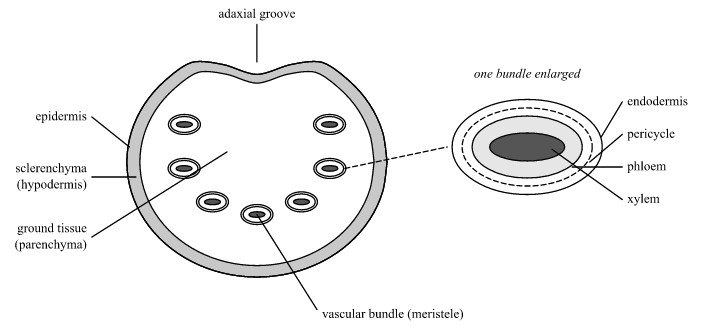
(b)(ii) (7 marks)Cut thin sections with a sharp razor, put the best one in a drop of water on a slide, cover and view under low power
A tissue plan shows only the outlines of tissue regions, not cells
Drawing of the transverse section of the rachis of specimen G (tissue plan)
Expected features: outer epidermis; a band of sclerenchyma (hypodermis) for support; ground parenchyma;
several vascular bundles (meristeles) arranged in a horseshoe (U) open towards the upper groove;
each bundle with endodermis, pericycle, phloem around a central xylem (concentric bundle)
(c)(i) (4 marks)1. Thallus is a flat, leaf-like (foliose) or crusty plate, grey-green to yellowish, with no roots, stem or leaves
2. Upper surface is coloured; the lower surface is paler, with root-like threads (rhizines) attaching it to the bark or rock
3. Cup-shaped or disc-like reproductive bodies (apothecia) and powdery patches (soredia) may be seen on the upper surface
4. It is a partnership: fungal threads (hyphae) surround algal cells that photosynthesise
(c)(ii) (3 marks)1. Pioneer organism: colonises bare rock and bark; its acids weather rock and its dead remains begin soil formation (succession)
2. Indicator of air pollution: lichens die where sulphur dioxide is high, so their presence shows clean air
3. Lichens with cyanobacterial partners fix nitrogen, adding nitrates to the ecosystem
4. Food and shelter for small animals (insects, snails)
Answer: E: Chlorophyta (chlorophyll in chloroplasts, simple undifferentiated filament). G: fern frond; rachis tissue plan with sclerenchyma and a horseshoe of concentric bundles. F (lichen): pioneer, pollution indicator, nitrogen fixer.
Tip: In a tissue plan never draw individual cells; outline each tissue region and label it