What we are solvingExplain the fluid-mosaic model of the membrane, three roles of internal membranes,
and the part played by rough ER and Golgi in making and secreting enzymes
Chapter: Cell biology
Topic: membrane structure and function; secretion
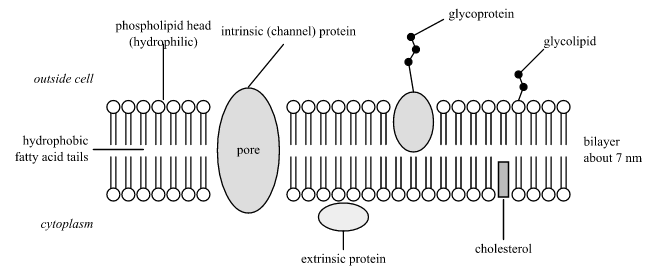
(a) (2 marks)Fluid: the phospholipid molecules and many proteins move about sideways within the bilayer, so the membrane is not rigid
Mosaic: protein molecules are scattered in the phospholipid bilayer like tiles of a mosaic
(b) (3 marks)Divide the cell into compartments, so different reactions run separately (e.g. lysosome enzymes kept apart)
Provide a large surface for enzymes and reactions (e.g. cristae for respiration, thylakoids for photosynthesis)
Transport and package materials within the cell (ER channels, Golgi vesicles)
Control what enters and leaves organelles (e.g. nuclear envelope pores)
(c)(i) (2 marks)Ribosomes on the rough ER make the enzyme proteins
The proteins pass into the ER lumen, are folded, and carried in transport vesicles to the Golgi
(c)(ii) (3 marks)Vesicles from the ER fuse with the Golgi (forming face)
Golgi modifies the enzymes (e.g. adds carbohydrate) and packages them
Secretory vesicles pinch off, move to the plasma membrane and release the enzyme by exocytosis
Answer: (a) moving lipids and proteins; proteins scattered in the bilayer. (b) compartments, surface for enzymes, transport. (c) RER makes and carries enzymes; Golgi modifies, packages and secretes them by exocytosis.
Tip: In 'explain' parts give one point per mark.