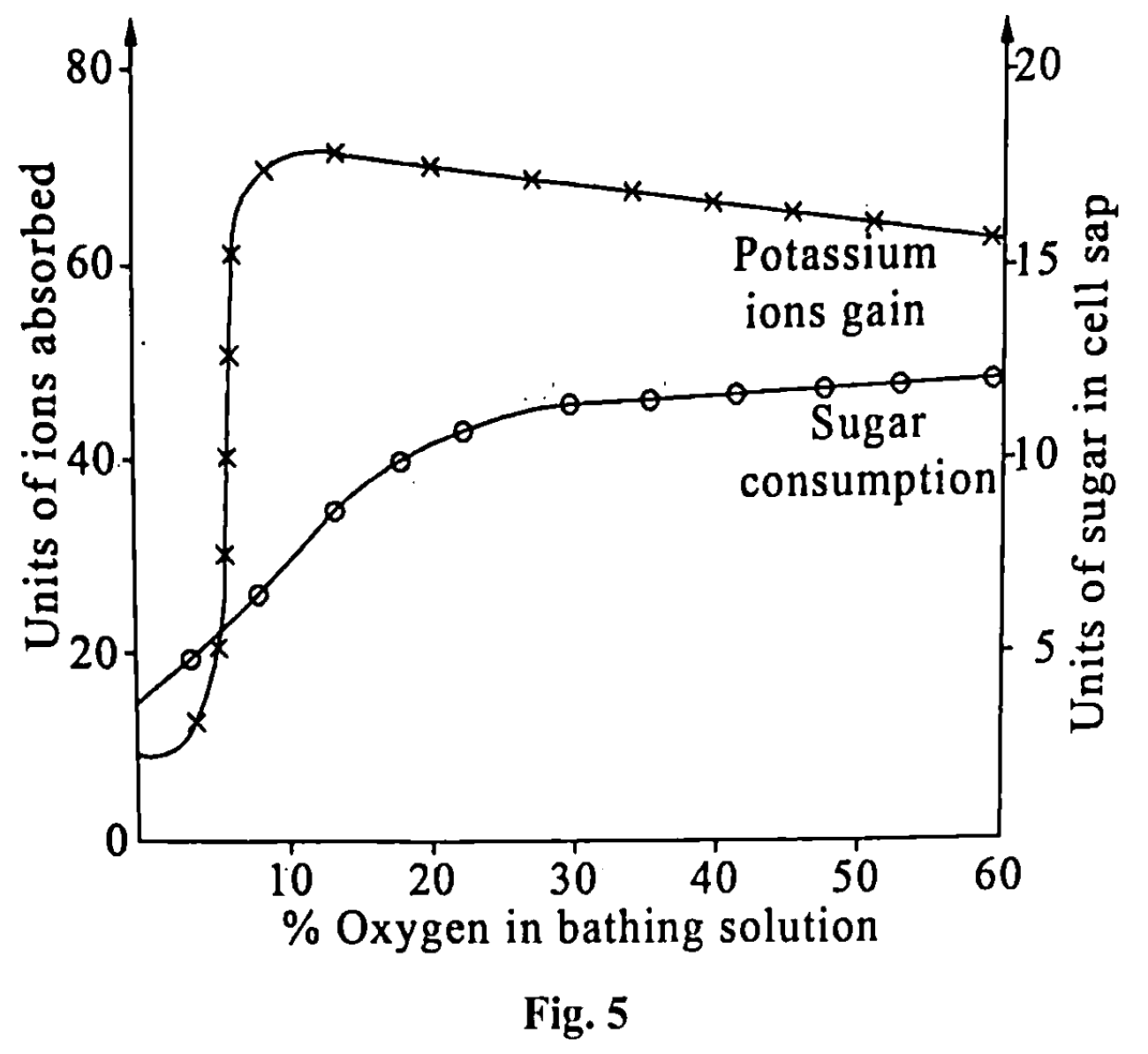
What we are solvingFig. 5 shows potassium ion uptake and sugar use by barley roots at different oxygen percentages
Explain the curves, give another factor affecting ion uptake, and describe the apoplast route of
K+ to the xylem
Chapter: Transport in plants
Topic: active uptake of mineral ions
(a)(i) (3 marks)From 0 to about 5 % oxygen,
K+ uptake is low (about 10–20 units): little aerobic respiration, little ATP
From about 5 % to 8 % uptake rises very steeply to about 70 units, reaching a maximum of about 72 near 13 %: more oxygen, more aerobic respiration, more ATP for the carrier pumps
Above about 13 % uptake falls slightly (to about 63 at 60 %): another factor (number of carriers) limits, and high oxygen may slightly injure the cells
So
K+ uptake is active and depends on aerobic respiration
(a)(ii) (2 marks)Both rise as oxygen increases at first: more sugar is respired to give the ATP used for
K+ uptake
Above about 13 % oxygen sugar use keeps rising slowly while
K+ uptake falls slightly, so not all extra respiration goes into ion uptake
(b) (1 mark)Temperature (any one: temperature, pH of soil, presence of respiratory inhibitors, concentration of the ion in the soil, light)
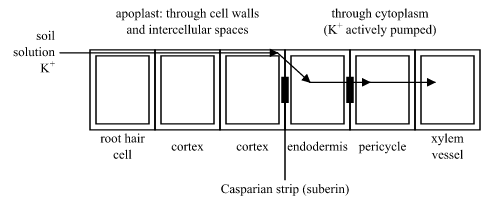
(c) (4 marks)K+ ions dissolve in the soil water and enter the cell walls of the root hair
They move with water through the cell walls and intercellular spaces of the cortex (apoplast) by diffusion and mass flow
At the endodermis the suberin of the Casparian strip blocks the walls
Ions are actively taken into the endodermal cytoplasm (selective uptake)
They pass on to the pericycle and are actively pumped into the xylem vessels, then carried up in the transpiration stream
Answer: (a)(i) uptake rises sharply to a maximum near 13 % oxygen: active uptake using ATP from aerobic respiration; (ii) sugar use rises with K uptake. (b) temperature. (c) cell walls of cortex, then through endodermal cytoplasm past the Casparian strip, then into xylem.