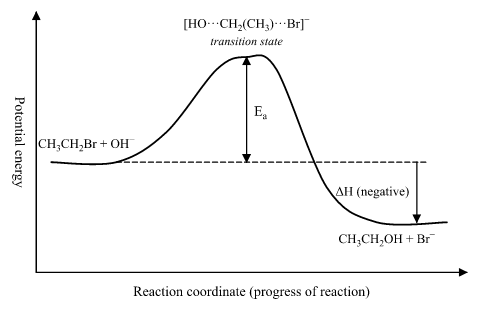
What we are solvingBromoethane is hydrolysed by aqueous sodium hydroxide on heatingWe need the mechanism, its name, the rate equation, an energy profile and a route to propanalChapter: Haloalkanes; Reaction kineticsTopic: nucleophilic substitution (SN2); Grignard reagentsConcept and formulasBromoethane is a primary haloalkane: the C–Br carbon is Cδ+ and not crowdedOH− attacks from the side opposite Br; the C–O bond forms as the C–Br bond breaks, in one stepBoth reactants are in the one step, so the rate depends on both concentrationsWorking(a)(02 marks)NaOH(aq)⟶Na(aq)++OH(aq)−HO−+CH3CH2−Br⟶[HO⋯CH2(CH3)⋯Br]−⟶CH3CH2OH+Br−The lone pair on OH− attacks the carbon; the C–Br bonding pair moves onto Br, which leaves as Br−(b)(01 mark)Bimolecular nucleophilic substitution (SN2)(c)(01 mark)Rate=k[CH3CH2Br][OH−](d)(2½ marks)One hump (one step), with the transition state at the top; products lie lower than reactants (exothermic)
(e)(2½ marks)One carbon must be added: use a Grignard reagent with methanal, then oxidise the primary alcoholCH3CH2Br+Mgdry etherCH3CH2MgBrCH3CH2MgBr+HCHO⟶CH3CH2CH2OMgBrCH3CH2CH2OMgBr+H2OH+CH3CH2CH2OH+Mg(OH)BrCH3CH2CH2OHK2Cr2O7/H+,distil off at onceCH3CH2CHOThe aldehyde is distilled off as it forms so that it is not oxidised further to propanoic acidAnswer: SN2; Rate =k[CH3CH2Br][OH−]; one-hump exothermic profile; CH3CH2Br→CH3CH2MgBr→CH3CH2CH2OH→CH3CH2CHOTip: Label both axes, Ea and ΔH on an energy profile; an unlabelled hump earns little