What we are solving(a) A 2% solution of monomer M is isotonic with 1.65 g of a polymer (
Mr 1040) in 11.6
cm3 at 298 K; find
Mr of M
(b) For three monomers: the polymer, the type of polymerisation and one use
Chapter: Colligative properties; Polymers
Topic: osmotic pressure; addition and condensation polymers
Concept and formulasπV=nRT⇒π=VnRT=cRTAt the same temperature, equal osmotic pressures mean equal molar concentrations
2% means 2 g of M in 100
cm3 of solution
Working(a) (03 marks)Polymer:
n=10401.65=1.587×10⁻³ mol in
11.6 cm3c=11.6×10−31.587×10−3=0.1368 moldm−3Monomer: 2 g per 100
cm3 = 20 g per
dm3, and its concentration is also 0.1368
moldm−3Mr=0.136820=146(The same result from
π:
π=0.1368×1000×8.31×298=3.39×10⁵ Pa for both solutions)
(b) (06 marks)(i)
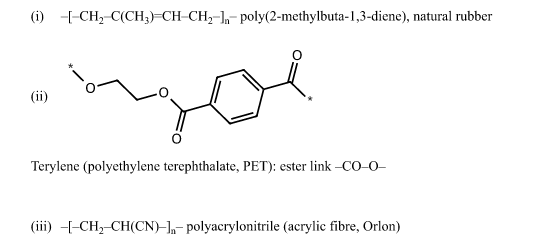
CH2=C(CH3)−CH=CH2 (2-methylbuta-1,3-diene, isoprene)
Polymer:
−[CH2−C(CH3)=CH−CH2]n− (polyisoprene, natural rubber)
Type: addition polymerisation
Use: making car tyres
(ii)
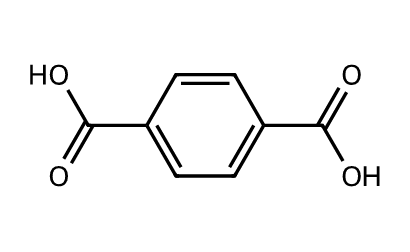
HOCH2CH2OH and benzene-1,4-dicarboxylic acid
Polymer:
−[O−CH2CH2−O−CO−C6H4−CO]n− (Terylene, PET); water is lost at each ester link
Type: condensation polymerisation
Use: making textile fibres for clothing (and plastic bottles)
(iii)
CH2=CH−CN (propenenitrile)
Polymer:
−[CH2−CH(CN)]n− (polyacrylonitrile, Orlon/Acrilan)
Type: addition polymerisation
Use: making acrylic fibres for clothes, blankets and carpets
Answer: (a)
Mr of M = 146; (b) natural rubber (addition, tyres); Terylene (condensation, fabrics); polyacrylonitrile (addition, acrylic fibres)
Tip: Addition polymers keep all the atoms of the monomer; condensation polymers lose a small molecule such as water