What we are solvingHydrogen peroxide decomposes:
2H2O2(aq)→2H2O(l)+O2(g)We define order, write the rate law, describe how the order is found and how temperature acts
Then we plot Table 1, read two half-lives from the graph and find the order and the rate constant
Chapter: Chemical kinetics (reaction rates)
Topic: order of reaction, rate law, half-life, effect of temperature
Concept and formulasRate law:
rate=k[A]n, where
k is the rate constant and
n the order
For a first order reaction the half-life is constant, whatever the starting concentration:
t1/2=kln2=k0.693t1/2 = time for the concentration to fall to half its value
(a) (01 mark)The order of a reaction is the sum of the powers to which the concentrations of the reactants are raised in the experimentally determined rate equation.
(b)(i) (1½ marks)Rate=−dtd[H2O2]=k[H2O2]nk = rate constant,
n = order with respect to
H2O2 (found by experiment to be 1 here, so rate
=k[H2O2])
(b)(ii) (05 marks)Prepare a known volume of hydrogen peroxide solution of known concentration in a flask kept in a water bath at constant temperature.
Add a catalyst (a little manganese(IV) oxide or potassium iodide solution) and start a stop clock at once.
At regular time intervals, pipette a fixed volume (e.g.
10 cm3) of the mixture into excess ice-cold dilute sulphuric acid to stop (quench) the reaction.
Titrate each portion against standard potassium manganate(VII) solution until the first permanent pink colour:
2MnO4−(aq)+5H2O2(aq)+6H+(aq)→2Mn2+(aq)+5O2(g)+8H2O(l)The titre is proportional to
[H2O2] remaining. (Alternatively, collect the oxygen in a gas syringe and read its volume at intervals.)
Plot
[H2O2] (or titre) against time and read successive half-lives from the curve.
If the half-lives are constant the reaction is first order; also a plot of
log[H2O2] against time is a straight line for first order.
(b)(iii) (3½ marks)An increase in temperature increases the rate of decomposition of hydrogen peroxide.
At a higher temperature the molecules have more kinetic energy.
A greater fraction of molecules then has energy equal to or greater than the activation energy.
So more effective collisions (successful decompositions) occur per second, and the rate constant
k increases (
k=Ae−Ea/RT).
Roughly, the rate doubles for every
10 ∘C rise in temperature.
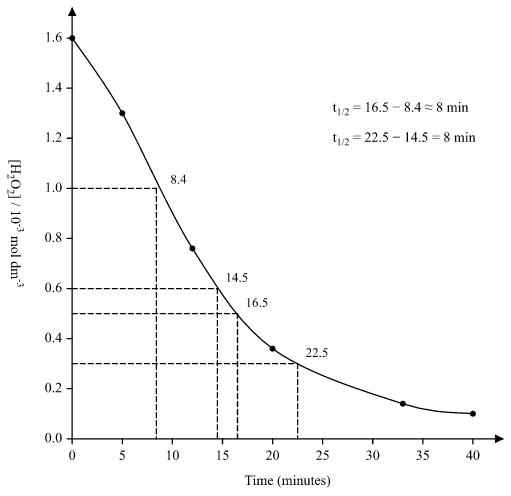
(c) (04 marks)Plot concentration (vertical axis) against time in minutes (horizontal axis) with a suitable scale, mark the six points and draw a smooth curve through them.
(d)(i) (01 mark)From the graph:
[H2O2]=1.0×10⁻³ at
t≈8.4 min and
5.0×10⁻⁴ at
t≈16.5 min
t=16.5−8.4≈8 min(d)(ii) (01 mark)From the graph:
6.0×10⁻⁴ at
t≈14.5 min and
3.0×10⁻⁴ at
t≈22.5 min
t=22.5−14.5=8 min(Readings from a hand-drawn graph within about
±0.5 min are acceptable.)
(e)(i) (1½ marks)In both cases the concentration halves in the same time (about 8 min).
The half-life is constant and does not depend on the starting concentration.
Therefore the decomposition of hydrogen peroxide is a first order reaction.
(e)(ii) (1½ marks)k=t1/20.693=8 min0.693k≈0.087 min−1 (≈1.4×10⁻³ s−1)Answer: rate
=k[H2O2]; both times ≈ 8 min, so constant half-life ⇒ first order;
k≈0.087 min−1Tip: Draw the half-life lines on your graph so the examiner sees where each reading came from.