Test Index
UACE Chemistry 2022 Paper 2 (Theory)
© africaexams.com
Question : 2
Total: 8
Solution:
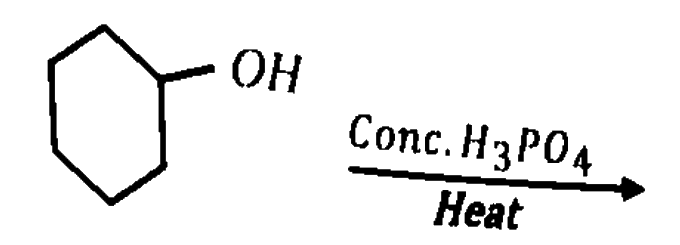
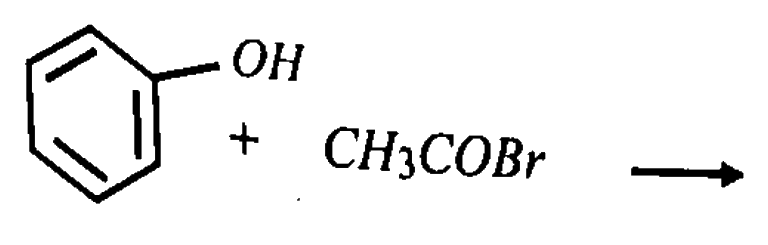
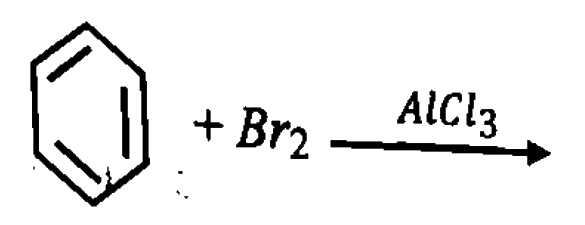
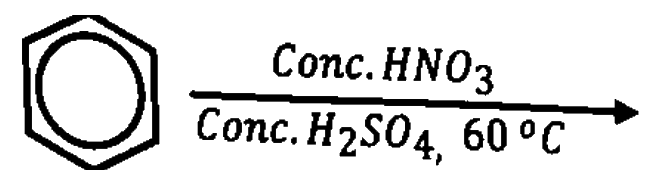
What we are solvingFive organic reactions: complete each equation and write the mechanism(a) cyclohexanol with conc. phosphoric acid, (b) phenol with ethanoyl bromide, (c) 2-chloropropane with sodium methoxide, (d) bromination and (e) nitration of benzeneChapter: Organic chemistry (alcohols, phenols, haloalkanes, aromatic hydrocarbons)Topic: elimination, acylation and electrophilic substitution mechanismsConcept and formulasAcid + heat on an alcohol: elimination of water (dehydration) to an alkeneAcid halide + phenol: nucleophilic addition–elimination (acylation) to an esterStrong base + heat on a secondary haloalkane: E2 elimination to an alkeneBenzene + electrophile with a catalyst: electrophilic substitution (the ring keeps its aromatic stability)The products of all five reactions: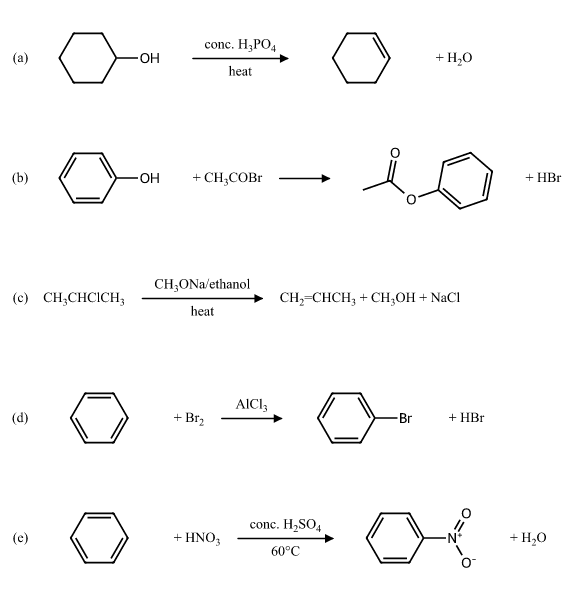 (a) (04 marks)C6H11OHconc. H3PO4heatC6H10+H2O (cyclohexanol → cyclohexene)Mechanism (E1, acid-catalysed dehydration)Step 1: the lone pair on the OH oxygen takes a proton from the acid: C6H11–OH+H+→C6H11–OH2+Step 2: the protonated alcohol loses a water molecule, giving a secondary carbocation: C6H11–OH2+→C6H11++H2OStep 3: H2PO4− (or water) removes a proton from a carbon next to the positive carbon; the C–H electrons form the C=C bond: C6H11+→C6H10+H+The acid is regenerated, so it acts as a catalyst.(b) (4½ marks)C6H5OH+CH3COBr→CH3COOC6H5+HBr (phenyl ethanoate)Mechanism (nucleophilic addition–elimination)Step 1: a lone pair on the phenol oxygen attacks the electron-deficient carbonyl carbon of CH3COBr; the C=O π electrons move onto the oxygen.This gives a tetrahedral intermediate: CH3C(O−)(Br)–O+(H)C6H5Step 2: the C=O bond reforms and bromide ion is expelled (good leaving group).Step 3: the bromide ion removes the proton from the positively charged oxygen: Br−+H+→HBr, leaving CH3COOC6H5.(c) (03 marks)CH3CHClCH3+CH3ONaethanolheatCH3CH=CH2+CH3OH+NaCl (propene)Mechanism (E2, one step)The methoxide ion CH3O−, a strong base, removes a proton from a carbon next to the C–Cl carbon.At the same time the C–H electrons form the C=C bond and the C–Cl bond breaks, releasing Cl−:CH3O−+H–CH2–CHCl–CH3→CH3OH+CH2=CH–CH3+Cl−Heat and a strong base favour elimination over substitution (the ether is only a minor product).(d) (3½ marks)C6H6+Br2AlCl3C6H5Br+HBr (bromobenzene)Mechanism (electrophilic substitution)Step 1: the halogen carrier polarises bromine and forms the electrophile: Br2+AlCl3→Br++[AlCl3Br]−Step 2: the π electrons of the ring attack Br+, forming a positively charged intermediate (arenium ion, C6H6Br+); this step is slow.Step 3: [AlCl3Br]− removes the proton from the carbon carrying Br, restoring the aromatic ring:C6H6Br++[AlCl3Br]−→C6H5Br+HBr+AlCl3(e) (05 marks)C6H6+HNO3conc. H2SO460 ∘CC6H5NO2+H2O (nitrobenzene)Mechanism (electrophilic substitution)Step 1: the nitronium ion forms: HNO3+2H2SO4→NO2++H3O++2HSO4−Step 2: the π electrons of benzene attack NO2+, giving the arenium ion C6H6NO2+ (slow step).Step 3: HSO4− removes a proton and the aromatic ring is restored:C6H6NO2++HSO4−→C6H5NO2+H2SO4The temperature is kept at about 60 ∘C; above this, dinitration (1,3-dinitrobenzene) increases.Answer: (a) cyclohexene (E1); (b) phenyl ethanoate + HBr (addition–elimination); (c) propene (E2); (d) bromobenzene and (e) nitrobenzene (electrophilic substitution)Tip: In every mechanism show where the electrons go with curly arrows and name the electrophile or nucleophile.
© africaexams.com
Go to Question:
Advertisements