What we are solvingWhy fluorine differs from the other group (VII) elements, with reactions and equations
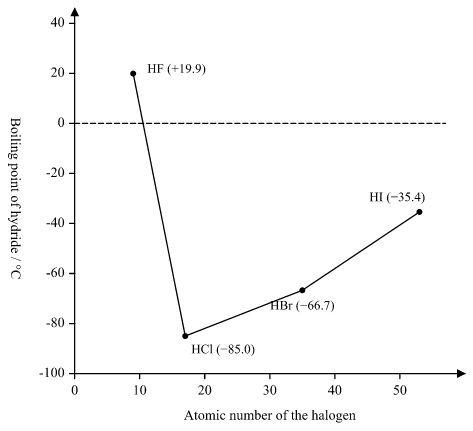
Plot and explain the boiling points of HF, HCl, HBr and HI (Table 2)
Observations and equations for thiosulphate with iodine, and chlorine with potassium bromide
Chapter: Group (VII) elements (the halogens)
Topic: anomalous behaviour of fluorine, hydrogen halides, redox reactions of halogens
Concept and formulasFluorine has the smallest atom and the highest electronegativity, and no low-lying d orbitals
Boiling point depends on the intermolecular forces: hydrogen bonds are much stronger than van der Waals forces
A more reactive halogen oxidises (displaces) the ion of a less reactive one
(a)(i) (01 mark)1. Fluorine has a very small atomic (and ionic) radius and is the most electronegative element.
2. Fluorine has no vacant d orbitals in its valence shell, so it cannot expand its octet (maximum covalency 1).
(Also: the F–F bond is unusually weak,
158 kJ mol−1, because of repulsion between lone pairs on the small atoms.)
(a)(ii) (06 marks)1. Reaction with waterFluorine oxidises water to oxygen:
2F2(g)+2H2O(l)→4HF(aq)+O2(g)Chlorine only disproportionates in water:
Cl2(g)+H2O(l)⇌HCl(aq)+HOCl(aq)2. Reaction with cold dilute sodium hydroxideFluorine gives oxygen difluoride:
2F2(g)+2NaOH(aq)→2NaF(aq)+OF2(g)+H2O(l)Chlorine gives chloride and chlorate(I):
Cl2(g)+2NaOH(aq)→NaCl(aq)+NaOCl(aq)+H2O(l)(Hot concentrated alkali:
2F2+4NaOH→4NaF+O2+2H2O, while
3Cl2+6NaOH→5NaCl+NaClO3+3H2O.)
(b)(i) (04 marks)Plot boiling point (vertical axis, from
−100 to
+40 ∘C) against atomic number (horizontal axis) and join the points.
(b)(ii) (4½ marks)The boiling point falls sharply from HF to HCl, then rises steadily from HCl to HI.
HF has an abnormally high boiling point: fluorine is small and highly electronegative, so the H–F bond is very polar.
HF molecules are held together by strong hydrogen bonds (
H–F⋯H–F), which need a lot of energy to break.
Cl, Br and I are larger and less electronegative, so HCl, HBr and HI do not form significant hydrogen bonds; they are held by weak van der Waals forces (and dipole–dipole attraction).
From HCl to HI the molecular size and number of electrons increase, so the molecules are more polarisable.
The van der Waals forces therefore get stronger, and the boiling point rises from HCl to HBr to HI.
(c)(i) (2½ marks)Observation: the brown (yellow-brown) iodine solution turns colourless.
2S2O32−(aq)+I2(aq)→S4O62−(aq)+2I−(aq)Iodine oxidises thiosulphate to tetrathionate and is itself reduced to colourless iodide ions.
(c)(ii) (02 marks)Observation: the colourless solution turns yellow/orange (brown) as bromine is formed.
Cl2(g)+2Br−(aq)→2Cl−(aq)+Br2(aq)Chlorine is a stronger oxidising agent than bromine, so it displaces bromine.
Answer: F small, most electronegative, no d orbitals; F₂ oxidises water to O₂ and gives OF₂ with NaOH; HF high b.p. (hydrogen bonding), HCl → HI rising (van der Waals); brown iodine decolourised; colourless KBr turns orange.
Tip: For "how fluorine differs" always write the fluorine equation AND the equation of another halogen to compare.