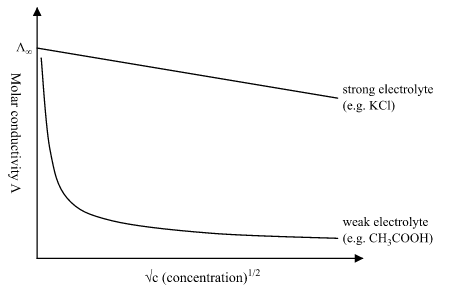
What we are solvingDistinguish the two conductivities, find a cell constant, then the solubility and solubility product of silver chloride from conductivity dataFinally explain how ionic radius and concentration affect molar conductivityChapter: Electrochemistry (electrolytic conductivity)Topic: conductivity, Kohlrausch's law, solubility from conductanceConcept and formulasElectrolytic conductivity: κ=R1×Al, where Al is the cell constant (cm−1)Molar conductivity: Λ=c1000κ, with c in mol dm−3, κ in Ω−1cm−1, Λ in Ω−1cm2mol−1Kohlrausch's law: Λ∞ of an electrolyte is the sum of the contributions of its ionsA saturated solution of a sparingly soluble salt is so dilute that Λ≈Λ∞(a)(i)(01 mark)Electrolytic conductivity is the conductance of a 1 cm3 cube of the solution (electrodes 1 cm2 in area, 1 cm apart); unit Ω−1cm−1.Molar conductivity is the conductance of the volume of solution containing one mole of the electrolyte placed between electrodes 1 cm apart; unit Ω−1cm2mol−1.(a)(ii)(3½ marks)Find the conductivity of 0.1 M KCl from its molar conductivity:κ=1000Λc=1000129×0.1=1.29×10⁻²Ω−1cm−1Cell constant = conductivity × resistance:Al=κR=1.29×10−2×484=6.24 cm−1(b)(i)(1½ marks)By Kohlrausch's law:Λ∞(AgCl)=Λ∞(AgNO3)+Λ∞(KCl)−Λ∞(KNO3)=133.4+149.9−145.0=138.3Ω−1cm2mol−1(b)(ii)(7½ marks)Step 1: remove the contribution of water (the solution's value includes the water's own ions):κ(AgCl)=3.41×10⁻⁶−1.60×10−6=1.81×10⁻⁶Ω−1cm−1Step 2: the saturated solution is very dilute, so Λ=Λ∞=138.3; the solubility c isc=Λ∞1000κ=138.31000×1.81×10−6=1.31×10⁻⁵ mol dm−3In grams: M(AgCl)=108+35.5=143.5 g mol−11.31×10−5×143.5=1.88×10⁻³ g dm−3Step 3: AgCl(s)⇌Ag+(aq)+Cl−(aq), so [Ag+]=[Cl−]=cKsp=[Ag+][Cl−]=(1.31×10⁻⁵)2=1.71×10⁻¹⁰ mol2dm−6(c)(i)(2½ marks)In water ions are hydrated; the smaller the ion, the higher its charge density and the more water molecules it attracts.So a small ion has a large hydrated radius, moves slowly towards the electrode and gives a lower molar conductivity.A larger ion (e.g. K+) is less hydrated, moves faster and gives a higher molar conductivity: Li+<Na+<K+.(c)(ii)(04 marks)Molar conductivity increases as the concentration decreases (on dilution) and reaches a maximum, Λ∞, at infinite dilution.Strong electrolyte (e.g. KCl): fully ionised at all concentrations. At high concentration the ions are close; each ion is held back by its oppositely charged ionic atmosphere, so mobility is low. On dilution the ions are further apart, interionic attraction falls and Λ rises slowly (almost linearly with c).Weak electrolyte (e.g. ethanoic acid): only partly ionised. On dilution the degree of ionisation increases greatly, so the number of ions per mole rises and Λ increases sharply at low concentration.
Answer: cell constant =6.24 cm−1; Λ∞(AgCl)=138.3Ω−1cm2mol−1; solubility =1.31×10⁻⁵ mol dm−3 (1.88×10⁻³ g dm−3); Ksp=1.71×10⁻¹⁰ mol2dm−6Tip: Always subtract the conductivity of water for a sparingly soluble salt; forgetting it nearly doubles the answer.