What we are solvingMetal X (relative atomic mass 24) and its oxide XO each react with hydrochloric acid FA1
We measure the temperature rise of 100
cm3 of FA1 for each reaction
From the two heats of reaction we use Hess's law to find
ΔH for
XO(s)+H2(g)→X(s)+H2O(l)With
X=24, X behaves as magnesium and XO as magnesium oxide (Mr = 40)
Chapter: Energetics (thermochemistry)
Topic: enthalpy of reaction by calorimetry and Hess's law
Concept and formulasBoth reactions are exothermic: the heat given out warms the solution
Heat given out:
q=mcΔTm = mass of solution (g) = volume in
cm3 × density 1
g cm−3c = specific heat capacity = 4.2
J g−1K−1;
ΔT = maximum temperature rise (K)
Molar heat of reaction:
ΔH=−nq with
n = moles of solid used (acid in excess)
Hess's law: the enthalpy change of a reaction is the same whatever the route
Working: procedure and tables1. Weigh the container with about 1.2 g of X, tip X out, reweigh the empty container; mass of X = difference
2. Put 100
cm3 of FA1 in a plastic cup (a poor conductor, so little heat is lost); record the initial temperature at time 0
3. Add all of X at once, start the clock, stir gently with the thermometer and read the temperature every half-minute up to 4 minutes
4. Repeat with about 2.0 g of Y using fresh FA1 (Part II)
Record each set in the table: Time (minutes) 0, ½, 1 ... 4 and Temperature of solution (°C), readings to 0.5 °C
Sample readings (your own readings will differ):
Part I: container + X = 13.45 g, container = 12.25 g, mass of X = 1.20 g
| Time (min) | 0 | ½ | 1 | 1½ | 2 | 2½ | 3 | 3½ | 4 |
| Temp. (°C) | 25.0 | 45.0 | 62.0 | 68.5 | 70.0 | 69.0 | 68.0 | 67.0 | 66.0 |
Part II: container + Y = 14.30 g, container = 12.30 g, mass of Y = 2.00 g
| Time (min) | 0 | ½ | 1 | 1½ | 2 | 2½ | 3 | 3½ | 4 |
| Temp. (°C) | 25.0 | 36.0 | 39.5 | 40.5 | 40.5 | 40.0 | 39.5 | 39.0 | 38.5 |
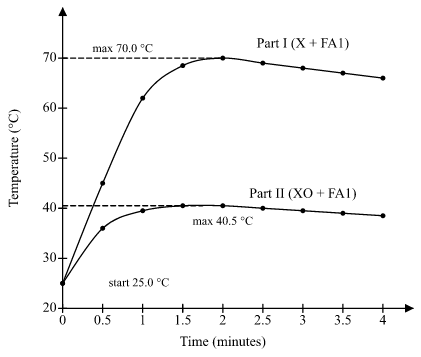
(a)(i) (07 marks)Time (minutes) on the horizontal axis, temperature (°C) on the vertical axis; both sets on the same axes
Choose scales that use most of the graph paper; the temperature axis may start at 20 °C
Plot every point clearly, draw a smooth curve through each set and label the curves Part I and Part II
Each curve rises quickly while the solid reacts, reaches a maximum, then falls slowly as the cup loses heat
(a)(ii) (03 marks)Maximum temperature change = highest temperature on the curve − initial temperature
Part I:
ΔT1=70.0−25.0=45.0 KPart II:
ΔT2=40.5−25.0=15.5 K(a)(iii) (01 mark + 01 mark)Mass of solution = 100
cm3 × 1
g cm−3 = 100 g in each case
Part I: q1=100×4.2×45.0=18900 J=18.9 kJPart II: q2=100×4.2×15.5=6510 J=6.51 kJ(a)(iv) (03 marks)Moles of X:
n1=241.20=0.0500 molMolar mass of XO = 24 + 16 = 40
g mol−1Moles of XO:
n2=402.00=0.0500 molPart I:
ΔH1=−0.050018.9=−378 kJ mol−1X(s)+2HCl(aq)→XCl2(aq)+H2(g),
ΔH1=−378 kJ mol−1Part II:
ΔH2=−0.05006.51=−130.2 kJ mol−1XO(s)+2HCl(aq)→XCl2(aq)+H2O(l),
ΔH2=−130.2 kJ mol−1Negative sign: heat is given out (exothermic)
(b) (02 marks)Reverse equation (1) and add it to equation (2):
XO(s)+2HCl(aq)→XCl2(aq)+H2O(l) ...
ΔH2XCl2(aq)+H2(g)→X(s)+2HCl(aq) ...
−ΔH1Adding (HCl and
XCl2 cancel):
XO(s)+H2(g)→X(s)+H2O(l)ΔH=ΔH2−ΔH1=−130.2−(−378)=+247.8 kJ mol−1Check with standard data (values not given in the paper):
ΔHf(H2O, l)=−286 kJ mol−1 and
ΔHf(MgO, s)=−602 kJ mol−1ΔH=−286−(−602)=+316 kJ mol−1The experimental value is lower mainly because heat is lost to the surroundings, most of all in the fast, hot Part I reaction
(c) (01 mark)ΔH is large and positive: the reaction is highly endothermic
So hydrogen cannot reduce the oxide of X (MgO) under ordinary conditions: XO is very stable because X is high in the reactivity series (above hydrogen)
Answer: Sample:
ΔT = 45.0 K and 15.5 K; heats 18.9 kJ and 6.51 kJ;
ΔH1=−378,
ΔH2=−130.2 kJ mol−1; reduction
ΔH≈+248 kJ mol−1 (theory +316): endothermic, XO is not reduced by hydrogen
Tip: In Hess cycles, reverse the equation whose products you need as reactants, and change the sign of its
ΔH