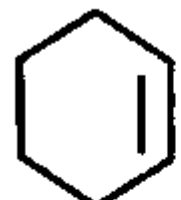
What we are solvingThree organic reactions: complete each equation and outline the mechanism(a) a tertiary bromoalkane with ethoxide in ethanol, heat; (b) ethanol with concentrated sulphuric acid at 140 °C; (c) cyclohexene with hydrogen bromideChapter: Organic chemistryTopic: elimination, ether formation and electrophilic addition mechanismsConcept and formulasA strong base in ethanol on heating removes HBr from a halogenoalkane (elimination), especially from a tertiary oneExcess ethanol with concentrated sulphuric acid at 140 °C gives ethoxyethane (at 170 °C ethene forms instead)Alkenes undergo electrophilic addition: H⁺ adds first to give a carbocation, then Br− addsWorking
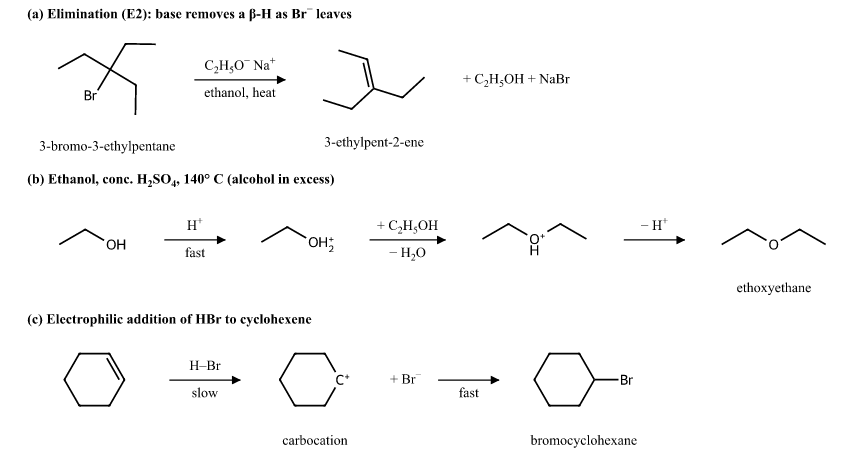
(a)(1 + 2 marks)(CH3CH2)3CBr+CH3CH2O−Na+→(CH3CH2)2C=CHCH3+CH3CH2OH+NaBrProduct: 3-ethylpent-2-eneMechanism (E2, one step):the ethoxide ion pulls off a hydrogen on a carbon next to the C–Br carbon;at the same time the C–H electron pair forms the C=C bond and the bromide ion leavesC2H5O−+H−CH(CH3)−C(C2H5)2−Br→C2H5OH+CH3CH=C(C2H5)2+Br−(Because the halide is tertiary, the reaction may also be shown as E1: slow loss of Br− to give (C2H5)3C+, then fast removal of a β-H by ethoxide)(b)(1 + 2 marks)2CH3CH2OHconc. H2SO4140∘CCH3CH2OCH2CH3+H2OMechanism:Step 1: the acid protonates the OH groupCH3CH2OH+H+→CH3CH2OH2+Step 2: a second ethanol molecule (nucleophile) attacks the CH2 carbon and water leavesCH3CH2OH+CH3CH2OH2+→CH3CH2O+HCH2CH3+H2OStep 3: loss of a proton gives the etherCH3CH2O+HCH2CH3→CH3CH2OCH2CH3+H+(c)(1 + 2 marks)C6H10+HBr→C6H11BrProduct: bromocyclohexaneMechanism (electrophilic addition):Step 1 (slow): the π electrons of C=C attack the δ+ hydrogen of H–Br; the H–Br bond breaks heterolytically, giving the cyclohexyl carbocation and Br−Step 2 (fast): the bromide ion attacks the positive carbon, giving bromocyclohexaneAnswer: (a) 3-ethylpent-2-ene, (C2H5)2C=CHCH3 (b) ethoxyethane, C2H5OC2H5 (c) bromocyclohexane, C6H11BrTip: In mechanisms draw curly arrows from a bond or lone pair to where the electrons go, and show charges on every ion