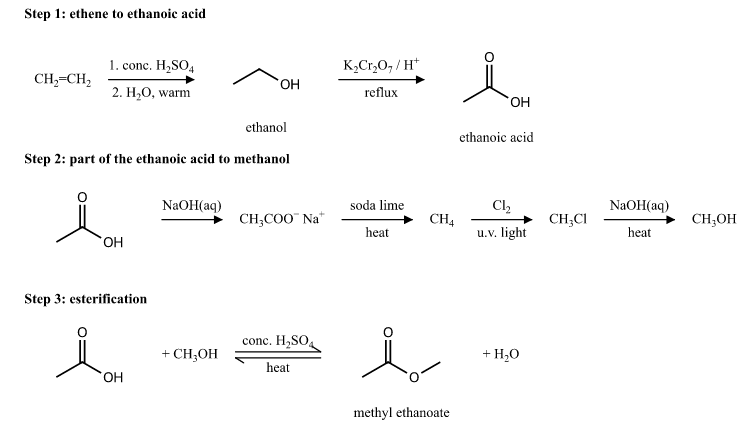
What we are solvingStart from ethene (C2) and make methyl ethanoate, CH3COOCH3The ester needs ethanoic acid (C2) and methanol (C1), so one carbon must be removed for the methanolChapter: Organic chemistryTopic: organic synthesis (alkenes, alcohols, acids, esters)Concept and formulasEthene → ethanol (hydration) → ethanoic acid (oxidation)Ethanoic acid → sodium ethanoate → methane (decarboxylation with soda lime, loses one carbon) → chloromethane → methanolEthanoic acid + methanol → methyl ethanoate (esterification)Working
Ethene to ethanol: absorb in concentrated sulphuric acid, then warm with waterCH2=CH2+H2SO4→CH3CH2OSO3HCH3CH2OSO3H+H2O→CH3CH2OH+H2SO4Ethanol to ethanoic acid: reflux with acidified potassium dichromate(VI)CH3CH2OH+2[O]→CH3COOH+H2OPart of the acid to sodium ethanoate, then heat with soda limeCH3COOH+NaOH→CH3COONa+H2OCH3COONa+NaOHheatCH4+Na2CO3Chlorinate methane in u.v. light, then hydrolyse with aqueous sodium hydroxideCH4+Cl2u.v.CH3Cl+HClCH3Cl+NaOHheatCH3OH+NaClEsterify: heat ethanoic acid with methanol and a little concentrated sulphuric acidCH3COOH+CH3OH⇌CH3COOCH3+H2O(Another accepted route to methanol: ethanoic acid → ethanamide → Br2/NaOH → methylamine → HNO2 → methanol)Answer: ethene → ethanol → ethanoic acid; part → sodium ethanoate → methane → chloromethane → methanol; ethanoic acid + methanol (conc. H2SO4) → methyl ethanoateTip: In a synthesis, first count the carbons of the target and of each part: here one part needs a step that removes a carbon