What we are solvingWe define two enthalpy terms, describe how to measure the enthalpy of combustion of ethanol (water:
c=4.2 J g−1K−1)
Then use
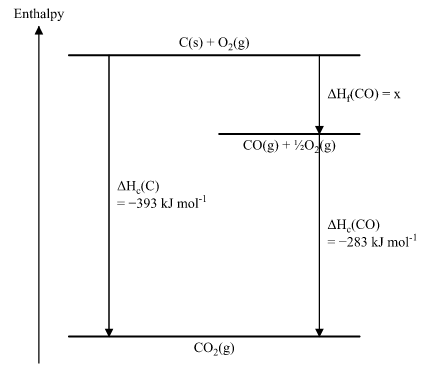
ΔHc(C)=−393 kJ mol−1 and
ΔHc(CO)=−283 kJ mol−1 in an energy cycle to find
ΔHf(CO)Finally, how
ΔH is used to judge whether a reaction is feasible
Chapter: Energetics (thermochemistry)
Topic: enthalpy of combustion, calorimetry, Hess's law, energy cycles
(a)(i) (01 mark)Molar enthalpy of combustion is the heat evolved when one mole of a substance is completely burnt in oxygen
(a)(ii) (01 mark)Standard enthalpy of atomisation is the heat absorbed when one mole of gaseous atoms is formed from the element in its standard state at 298 K and 1 atmosphere (101.325 kPa)
(b) (10 marks)ProcedureFill a spirit lamp with ethanol, put on its cap and weigh it: mass
m1 g
Put a known mass of water,
M g (e.g. measured volume,
1 cm3=1 g), into a copper calorimeter and record its initial temperature
T1Clamp the calorimeter just above the wick and surround it with a draught shield
Remove the cap, light the lamp and stir the water continuously
When the temperature has risen by about 20 °C, put out the flame (replace the cap at once to stop evaporation) and record the highest temperature
T2Reweigh the lamp with its cap: mass
m2 g
Treatment of resultsmass of ethanol burnt=(m1−m2) gmoles of ethanol=46m1−m2(Mr of C2H5OH=2(12)+6(1)+16=46)temperature rise θ=T2−T1heat absorbed by water=M×4.2×θ JThis heat came from burning
46m1−m2 mol of ethanol, so
ΔHc=−(m1−m2)×1000M×4.2×θ×46 kJ mol−1The value is negative because combustion is exothermic
Note: the value obtained is lower than the true value because of heat lost to the surroundings and to the calorimeter, and incomplete combustion
(c)(i) (03 marks)C(s)+O2(g)→CO2(g)ΔHc(C)=−393 kJ mol−1C(s)+21O2(g)→CO(g)ΔHf(CO)=xCO(g)+21O2(g)→CO2(g)ΔHc(CO)=−283 kJ mol−1The combustion of carbon is also the enthalpy of formation of carbon dioxide
(c)(ii) (02 marks)Hess's law: the enthalpy change from C + O
2 to CO
2 is the same by either route
ΔHc(C)=ΔHf(CO)+ΔHc(CO)−393=x+(−283)x=−393+283=−110 kJ mol−1(d) (03 marks)An exothermic reaction (
ΔH negative) gives products at a lower energy than the reactants, so the products are energetically more stable and the reaction is likely to be feasible
A reaction with a large positive
ΔH (endothermic) is usually not feasible at ordinary temperatures
But
ΔH alone is not a sure guide: feasibility depends on
ΔG=ΔH−TΔS, which must be negative; some endothermic reactions are feasible because of a large increase in entropy (e.g. dissolving ammonium chloride in water)
Answer: (c)(ii)
ΔHf(CO)=−110 kJ mol−1; (b)
ΔHc=−1000(m1−m2)46×4.2Mθ kJ mol−1; (d) negative
ΔH favours feasibility, but
ΔG decides
Tip: In an energy cycle, arrows that start and end at the same places must add up to the same total (Hess's law).