What we are solvingThermochemical data for Mg and Cl are given
We state factors affecting lattice energy, draw the Born-Haber (energy level) diagram for
MgCl2,
find its lattice energy, then its enthalpy of solution from hydration energies
Chapter: Energetics (thermochemistry)
Topic: Born-Haber cycle, lattice and hydration energies
Concept and formulasHess’s law: the enthalpy of formation equals the sum of all the steps of the cycle
ΔHf=ΔHat(Mg)+2ΔHat(Cl)+IE1+IE2+2EA+LEEnthalpy of atomisation of chlorine is per mole of Cl atoms, so it is doubled; electron affinity is also doubled
ΔHsoln=−LE+ΔHhyd(Mg2+)+2ΔHhyd(Cl−)Working(a) (1 mark)Size (radius) of the ions: smaller ions give a larger lattice energy
Charge on the ions: higher charges give a larger lattice energy
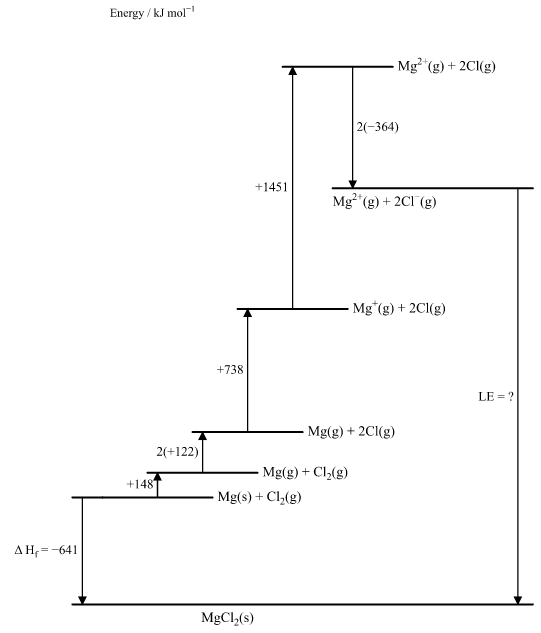
(b)(i) (3 marks)Energy levels (kJ mol
−1) starting from the elements at 0:
Mg(s)+Cl2(g): 0
Mg(g)+Cl2(g): +148
Mg(g)+2Cl(g): 148 + 244 = +392
Mg+(g)+2Cl(g): 392 + 738 = +1130
Mg2+(g)+2Cl(g): 1130 + 1451 = +2581
Mg2+(g)+2Cl−(g): 2581 − 728 = +1853
MgCl2(s): −641
(b)(ii) (2 marks)−641=148+2(122)+738+1451+2(−364)+LE−641=1853+LELE=−641−1853=−2494 kJ mol−1(b)(iii) (3 marks)Dissolving = breaking the lattice (+2494) then hydrating the ions
ΔHhyd total=−1891+2(−381)=−2653 kJ mol−1ΔHsoln=+2494+(−2653)=−159 kJ mol−1Negative: magnesium chloride dissolves exothermically
Answer: (a) ionic radius and ionic charge (b)(ii)
LE=−2494 kJ mol−1 (iii)
ΔHsoln=−159 kJ mol−1Tip: Remember the "2×" for the two chlorine atoms in both atomisation and electron affinity