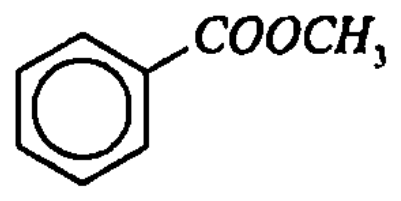
What we are solvingThree syntheses with equations and conditions:(a) 1-bromopropane from propanone (b) methyl benzoate from benzene (c) propene from 2-bromopropaneChapter: Organic chemistryTopic: organic synthesis (conversions)Concept and formulas(a) The C=O at C-2 must end as Br at C-1: reduce to the alcohol, dehydrate to propene, then add HBr against Markovnikov’s rule (peroxide)(b) Put a carbon on the ring (Friedel-Crafts), oxidise it to −COOH, then esterify with methanol(c) Elimination of HBr with ethanolic KOHWorking(a)(4 marks)Step 1: reduce propanone (LiAlH4 in dry ether, or NaBH4, or H2/Ni)CH3COCH3+2[H]→CH3CH(OH)CH3Step 2: dehydrate with conc. H2SO4 at 180 °C (or Al2O3, heat)CH3CH(OH)CH3→CH3CH=CH2+H2OStep 3: add HBr in the presence of an organic peroxide (anti-Markovnikov)CH3CH=CH2+HBrperoxideCH3CH2CH2Br(b)(3½ marks)Step 1: chloromethane with anhydrous AlCl3, warmC6H6+CH3ClAlCl3C6H5CH3+HClStep 2: oxidise with acidified (or alkaline, then acidify) KMnO4, heat under refluxC6H5CH3+3[O]→C6H5COOH+H2OStep 3: methanol with a little conc. H2SO4, heat under refluxC6H5COOH+CH3OH⇌C6H5COOCH3+H2O(c)(1½ marks)Heat under reflux with potassium hydroxide in ethanolCH3CHBrCH3+KOHethanolheatCH3CH=CH2+KBr+H2OAnswer: (a) reduce → propan-2-ol, dehydrate → propene, HBr/peroxide → 1-bromopropane (b) CH3Cl/AlCl3 → methylbenzene, KMnO4 → benzoic acid, CH3OH/H+ → methyl benzoate (c) ethanolic KOH, heatTip: Aqueous KOH substitutes (gives an alcohol); ethanolic KOH eliminates (gives an alkene)