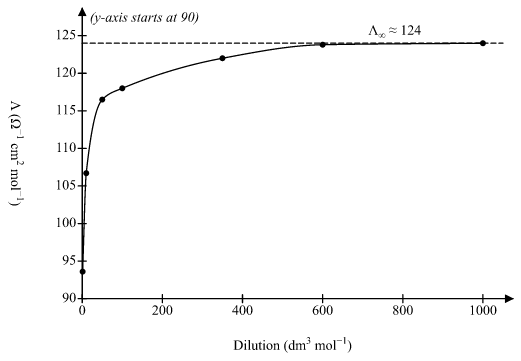
What we are solvingTable 2 gives the molar conductivity
Λ of sodium chloride at dilutions from 1 to 1000
dm3mol−1We define molar conductivity, plot
Λ against dilution, explain the shape, read
Λ∞, find the degree of dissociation of 0.01 M NaCl, and explain the effect of temperature
Chapter: Physical chemistry (electrolytic conductance)
Topic: molar conductivity, strong and weak electrolytes
Concept and formulasΛ=c1000κΛ = molar conductivity (
Ω−1cm2mol−1),
κ = electrolytic conductivity (
Ω−1cm−1),
c = concentration (
mol dm−3); 1000 changes
dm3 to
cm3α=Λ∞Λcα = degree of dissociation (conductivity ratio),
Λ∞ = molar conductivity at infinite dilution
Working(a) (02 marks)Molar conductivity is the conductivity of a solution containing one mole of the electrolyte, placed between two parallel electrodes 1 cm apart (and large enough to hold all the solution)
It equals
κ divided by the concentration:
Λ=1000κ/c, units
Ω−1cm2mol−1(b)(i) (04 marks)Plot dilution on the x-axis and molar conductivity on the y-axis; choose scales that use most of the graph paper; draw a smooth curve through the points
(b)(ii) (4½ marks)Sodium chloride is a strong electrolyte: it is fully ionised at all these concentrations
At low dilution (concentrated solution) the ions are close together
Each ion is surrounded by an ionic atmosphere of oppositely charged ions; interionic attraction (and the drag of this atmosphere) slows the ions, so
Λ is low
As the solution is diluted, the ions move further apart, interionic attraction falls, the ions move faster, and
Λ rises steeply at first
At high dilution the ions are so far apart that interionic attraction is negligible;
Λ levels off at a maximum,
Λ∞(b)(iii) (½ mark)From the flat part of the graph:
Λ∞≈124 Ω−1cm2mol−1(b)(iv) (03 marks)Molar conductivity of the 0.01 M solution:
Λ=0.011000×1.18×10−3=118 Ω−1cm2mol−1(Check: 0.01 M is a dilution of 100
dm3mol−1, and Table 2 gives 118.0 there)
α=Λ∞Λc=124118=0.95Degree of dissociation
≈0.95 (95 %)
(c)(i) (02 marks)A strong electrolyte is already fully ionised, so its degree of dissociation stays about 1 (unchanged)
Molar conductivity increases slightly: the solution becomes less viscous and the ions gain kinetic energy (and are less hydrated), so they move faster
(c)(ii) (04 marks)A weak electrolyte is only partly ionised:
HA+H2O⇌H3O++A−Ionisation needs energy (it is endothermic), so a rise in temperature shifts the equilibrium to the right
The degree of dissociation increases, giving more ions
Molar conductivity increases a lot: there are more ions and each moves faster (lower viscosity, more kinetic energy)
Answer:(b)
Λ rises steeply then levels off;
Λ∞≈124 Ω−1cm2mol−1;
α≈0.95(c) Strong:
α unchanged,
Λ rises slightly; weak:
α and
Λ both rise markedly
Tip: Dilution is the volume containing one mole, so dilution
=1/c;
Λ =
κ × dilution in
cm3