Test Index
UACE Chemistry 2024 Paper 2 (Theory)
© africaexams.com
Question : 6
Total: 8
Solution:
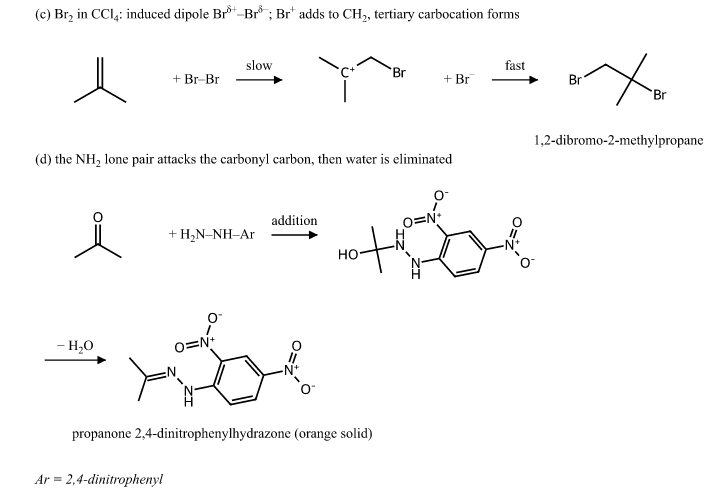
What we are solvingFor four pairs of compounds we give the conditions, the products and the mechanism(a) 2-chloropropane + sodium hydroxide; (b) benzene + chloroethane; (c) 2-methylpropene + bromine in CCl4; (d) propanone + 2,4-dinitrophenylhydrazineChapter: Organic chemistry (reaction mechanisms)Topic: nucleophilic substitution and elimination, electrophilic substitution, electrophilic addition, nucleophilic addition-eliminationConcept and formulasNucleophiles (electron-pair donors, e.g. OH−, NH2 groups) attack electron-poor carbons (C−Cl, C=O)Electrophiles (electron-pair acceptors, e.g. CH3CH2+, Brδ+) attack electron-rich benzene rings and C=C bondsCurly arrows show the movement of an electron pair, from a lone pair or bond to the atom that receives itWorking(a) (07 marks)(i) With warm aqueous sodium hydroxide: nucleophilic substitution, giving propan-2-olCH3CHClCH3+NaOH(aq)warmCH3CH(OH)CH3+NaClMechanism (SN2): the C−Cl bond is polar, Cδ+−Clδ−The OH− lone pair attacks the Cδ+ from the side opposite the chlorineIn the transition state [HO⋯C⋯Cl]− the C−O bond is forming while the C−Cl bond is breakingThe C−Cl electrons leave with the chlorine as Cl−, giving propan-2-ol(A secondary halide can also react partly by SN1: Cl− leaves first to give (CH3)2CH+, which then bonds to OH−)(ii) With hot concentrated sodium hydroxide in ethanol: elimination, giving propeneCH3CHClCH3+NaOHethanol, heatCH3CH=CH2+NaCl+H2OMechanism (E2): OH− acts as a base and removes an H from C-1; that C−H bond pair moves to form the C=C bond, and at the same time the C−Cl bond breaks and Cl− leaves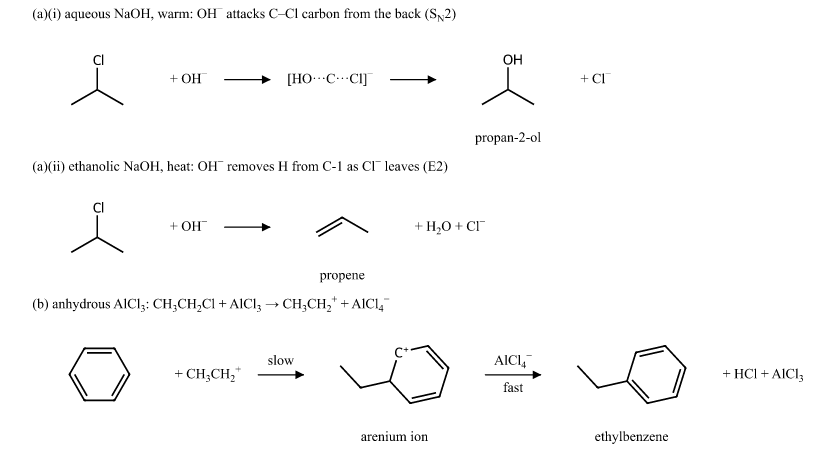 (b) (04 marks)Benzene reacts with chloroethane in the presence of anhydrous aluminium chloride (Friedel-Crafts alkylation) to give ethylbenzeneC6H6+CH3CH2Clanhydrous AlCl3C6H5CH2CH3+HClStep 1: the electrophile forms: CH3CH2Cl+AlCl3→CH3CH2++AlCl4−Step 2 (slow): the π electrons of benzene attack CH3CH2+, forming a carbocation (arenium ion) in which the ring delocalisation is brokenStep 3 (fast): AlCl4− removes the H+ from the ring carbon carrying the ethyl group; the ring is aromatic againH++AlCl4−→HCl+AlCl3The catalyst AlCl3 is regenerated(c) (03 marks)The red-brown bromine is decolourised; 1,2-dibromo-2-methylpropane forms (electrophilic addition)(CH3)2C=CH2+Br2CCl4(CH3)2CBrCH2BrStep 1: the π electrons of the C=C bond polarise the approaching bromine molecule, Brδ+−Brδ−The π electrons attack Brδ+; it bonds to the CH2 carbon and the Br−Br bond breaks, releasing Br−The more stable tertiary carbocation (CH3)2C+CH2Br formsStep 2: Br− bonds to the positive carbon(d) (06 marks)Propanone reacts with 2,4-dinitrophenylhydrazine (Brady's reagent, in acid) to give an orange-yellow precipitate of propanone 2,4-dinitrophenylhydrazone; this is a condensation (addition-elimination)(CH3)2C=O+H2NNHC6H3(NO2)2→(CH3)2C=NNHC6H3(NO2)2+H2OStep 1: the C=O bond is polar, Cδ+=Oδ− (an acid catalyst protonates the O and makes the carbon more positive)Step 2: the lone pair on the −NH2 nitrogen attacks the carbonyl carbon; the π electrons of C=O move onto oxygenStep 3: a proton moves from the nitrogen to the oxygen, giving the addition product (CH3)2C(OH)−NHNHArStep 4: the OH is protonated and lost as water; the N−H bond pair forms the C=N bond, and H+ is releasedThe orange crystals have a sharp melting point, used to identify the ketone
 Answer:(a) aqueous NaOH: propan-2-ol (SN); ethanolic NaOH: propene (E2) (b) ethylbenzene (electrophilic substitution, AlCl3)(c) 1,2-dibromo-2-methylpropane (electrophilic addition) (d) propanone 2,4-dinitrophenylhydrazone, orange precipitate (addition-elimination)Tip: State the conditions (solvent, temperature, catalyst) with every reaction; aqueous and ethanolic NaOH give different products
© africaexams.com
Go to Question:
Advertisements