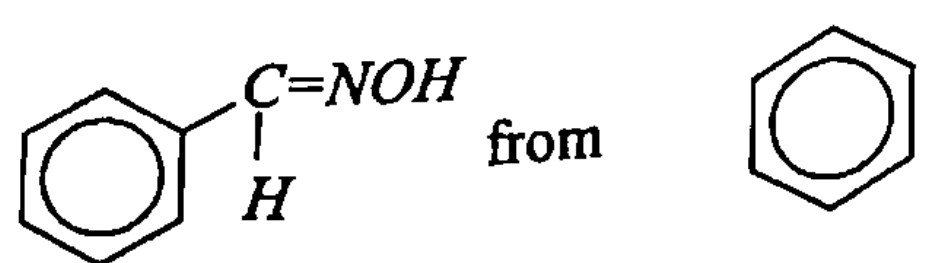
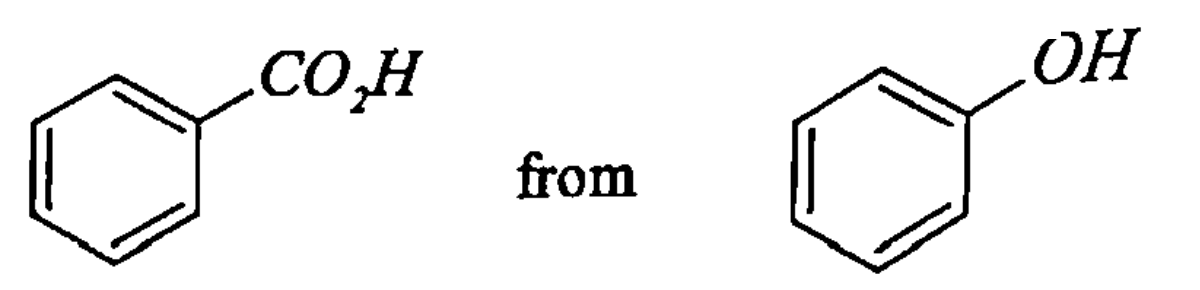
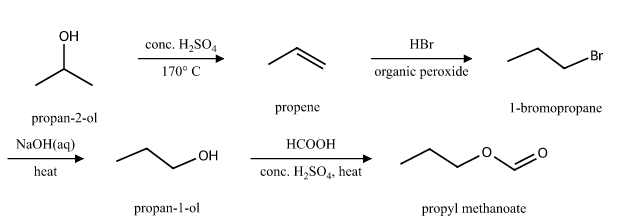
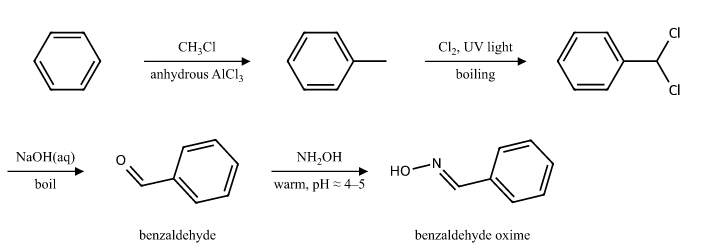
What we are solvingPlan syntheses, with reagents and conditions, of:(a) propyl methanoate HCOOCH2CH2CH3 from propan-2-ol; (b) benzaldehyde oxime C6H5CH=NOH from benzene; (c) benzoic acid from phenolChapter: Organic chemistryTopic: organic synthesis (conversions)Concept and formulasWork backwards from the target: an ester comes from an acid + alcohol; an oxime from an aldehyde + hydroxylamine; an aromatic acid from oxidising a side chainMoving an OH from C-2 to C-1: dehydrate to the alkene, then add HBr with peroxide (anti-Markovnikov), then hydrolyse(a) (3½ marks)(CH3)2CHOHconc. H2SO4170∘CCH3CH=CH2+H2OCH3CH=CH2+HBrorganic peroxideCH3CH2CH2BrCH3CH2CH2Br+NaOH(aq)heatCH3CH2CH2OH+NaBrHCOOH+CH3CH2CH2OHconc. H2SO4heatHCOOCH2CH2CH3+H2O
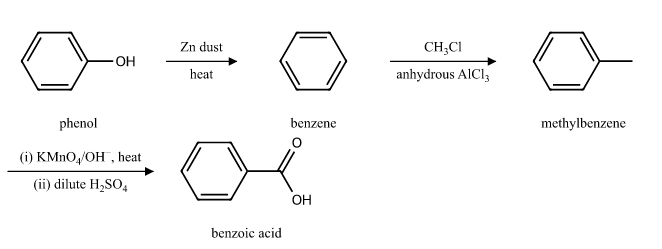
Answer:(a) dehydrate, HBr/peroxide, NaOH(aq), then esterify with HCOOH/conc. H2SO4(b) Friedel-Crafts methylation, side-chain chlorination, hydrolysis to benzaldehyde, then hydroxylamine(c) Zn dust, Friedel-Crafts methylation, then oxidation with KMnO4Tip: Write every step as an equation with the reagent above and the condition below the arrow.