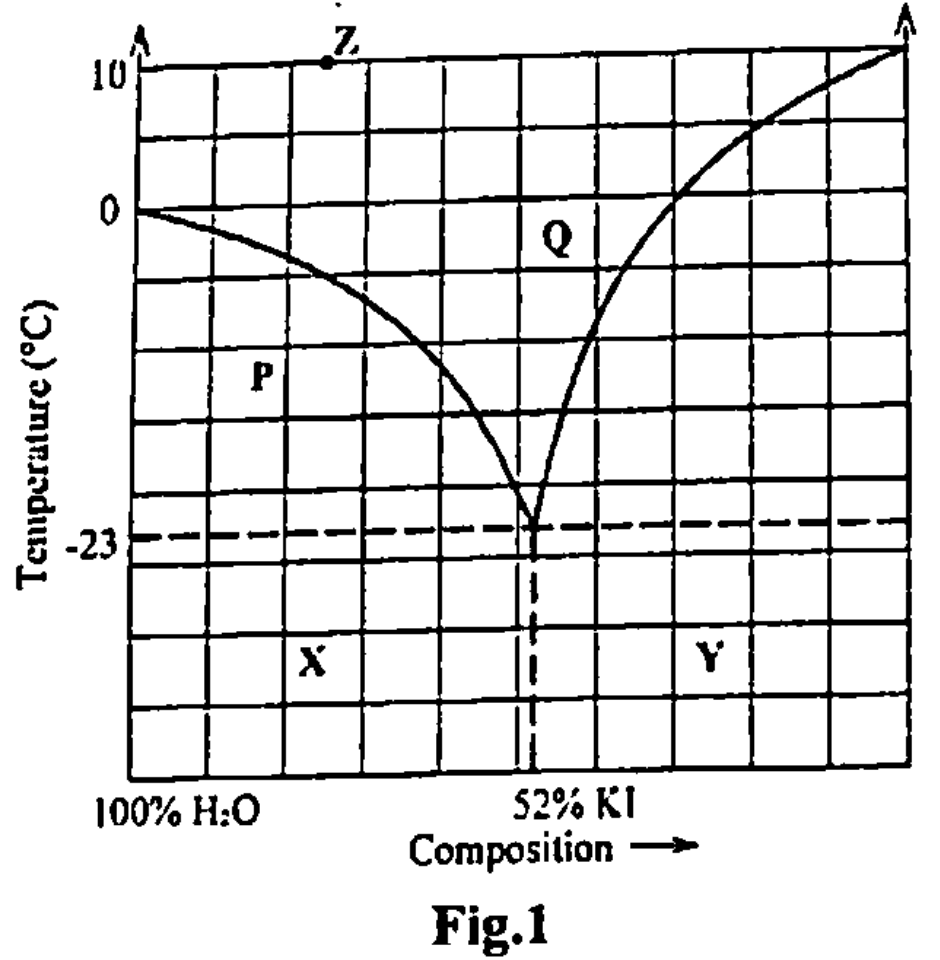
What we are solvingFig. 1 is the freezing-point (temperature-composition) diagram of KI and water, with a eutectic at
−23 ∘C and 52% KI
Describe cooling solution Z to
−24 ∘C, state properties of the 52% mixture, and identify the phases in P, X, Y and Q
Chapter: Phase equilibria
Topic: eutectic systems (salt-water freezing mixtures)
Concept and formulasThe left curve is the freezing-point curve of water: on it ice separates from the solution
The right curve is the solubility curve of KI: on it solid KI separates
The two curves meet at the eutectic point (
−23 ∘C, 52% KI); below it everything is solid
(a)(i) (02 marks)Z is an unsaturated KI solution (less than 52% KI) at about
10 ∘COn cooling, its temperature falls until it reaches the freezing-point curve; pure ice starts to separate
As ice separates the solution becomes richer in KI and its freezing point keeps falling along the curve
At
−23 ∘C the solution reaches 52% KI (eutectic): ice and KI crystallise together at constant temperature until all the liquid has solidified
Below that, down to
−24 ∘C, the solid cools: it is solid ice + solid eutectic mixture
(a)(ii) (01 mark)Any two:
It has the lowest freezing point of all KI-water mixtures (
−23 ∘C)
It melts/freezes sharply at a constant temperature, like a pure substance
The solid is a mixture of separate crystals of ice and KI (not a compound); its composition is constant at fixed pressure
(b) (½ mark each)(i) P: ice (solid) + KI solution (liquid)
(ii) X: solid ice + solid eutectic mixture
(iii) Y: solid KI + solid eutectic mixture
(iv) Q: unsaturated KI solution (one liquid phase)
Answer:(a)(i) ice separates, then the eutectic (ice + KI) solidifies at
−23 ∘C; at
−24 ∘C all is solid ice + eutectic
(b) P ice + solution; X ice + eutectic; Y KI + eutectic; Q solution
Tip: A eutectic is not a compound: it melts at a fixed temperature but shows two kinds of crystals under a microscope.