What we are solvingPart (a): define standard electrode potential and explain the factors that decide its sizePart (b): describe, with a diagram, how Eθ of the iodine electrode is measuredPart (c): use Eθ(I2/I−)=+0.54 V and Eθ(MnO4−/Mn2+)=+1.51 V to write the cell, find its e.m.f. and explain the manganate(VII) titrationPart (d): one use of electrode potentialsChapter: ElectrochemistryTopic: electrode potentials, electrochemical cells, redox titrationsConcept and formulasAn electrode potential measures the tendency of a half-cell to gain or lose electronsIt is measured against the standard hydrogen electrode (SHE), taken as 0.00 VEcell=Eright (reduction)θ−Eleft (oxidation)θThe half-cell with the more positive Eθ is reduced (cathode, right); the other is oxidised (anode, left)A positive Ecell means the reaction is feasibleWorking(a)(i)(1 mark)Standard electrode potential is the e.m.f. (potential difference) of a cell made of the electrode in a solution of its ions of concentration 1moldm−3 joined to the standard hydrogen electrode, measured at 25∘C (298 K) and 1 atmosphere pressure(a)(ii)(4½ marks)For a metal, Eθ depends on how easily M(s)→Mn+(aq)+ne− happensThis change goes in three steps; the energy of each step decides EθM(s)atomisationM(g)ionisationMn+(g)hydrationMn+(aq)1. Enthalpy of atomisation (sublimation): the larger it is, the harder it is to form free atoms, so the less readily ions form and the more positive (less negative) Eθ is2. Ionisation energy: the larger it is, the harder it is to remove electrons, so the more positive Eθ is3. Hydration energy: the more exothermic it is (small, highly charged ions), the more energy is given out when ions enter water, so ions form readily and Eθ is more negativeFor a non-metal such as iodine, the bond dissociation energy, the electron affinity and the hydration energy of the anion play the same rolesOverall: the more energy given out in forming the aqueous ion, the more negative the electrode potential(b)(5 marks)
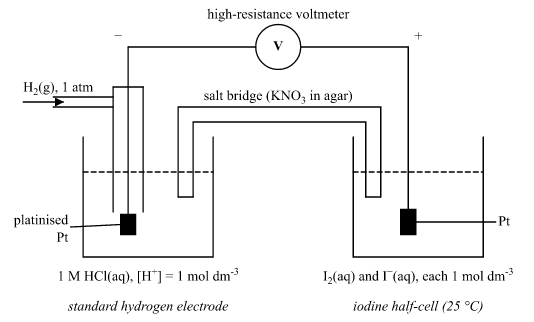
The iodine half-cell: a platinum electrode dips into a solution containing iodine and iodide ions, each at 1moldm−3Platinum is inert; it only carries electrons to and from the I2/I− coupleThe reference: the standard hydrogen electrode, platinised platinum in 1moldm−3H+ (1 M HCl) with pure hydrogen bubbled at 1 atmThe two solutions are joined by a salt bridge (saturated KNO3 in agar) to complete the circuit without mixing the solutionsThe electrodes are joined to a high-resistance voltmeter (or potentiometer) so that almost no current flows; the whole set-up is kept at 25∘CThe iodine electrode is found to be the positive electrode; the reading is the standard electrode potential:Ecellθ=Eθ(I2/I−)−0.00⇒Eθ(I2/I−)=+0.54V(c)(i)(2½ marks)The MnO4−/Mn2+ couple has the more positive Eθ (+1.51 V), so it is reduced (right-hand electrode)Iodide is oxidised to iodine (left-hand electrode)Cell notation:Pt(s)∣2I−(aq),I2(aq)∣∣MnO4−(aq),8H+(aq),Mn2+(aq)∣Pt(s)Half-equations (electrons balanced to 10):10I−(aq)→5I2(aq)+10e−2MnO4−(aq)+16H+(aq)+10e−→2Mn2+(aq)+8H2O(l)Overall cell reaction:2MnO4−(aq)+16H+(aq)+10I−(aq)→2Mn2+(aq)+5I2(aq)+8H2O(l)(c)(ii)(1½ marks)Ecell=Erightθ−EleftθEcell=1.51−0.54=+0.97VThe e.m.f. is positive, so the reaction is feasible(c)(iii)(4½ marks)No indicator: potassium manganate(VII) acts as its own indicatorIn acid, purple MnO4− is reduced to Mn2+, which is almost colourless, so the purple colour disappears as long as iodide remainsThe first drop in excess gives a permanent pink (purple) colour, which marks the end pointMore accurate in acid: H+ is a reactant of the MnO4− half-reaction, so a high [H+] makes its electrode potential more positive (Le Chatelier)The large e.m.f. (+0.97 V) means the reaction goes to completion quickly, so it is quantitativeIn acid, manganate(VII) takes exactly 5 electrons and is reduced to Mn2+ only; in neutral or alkaline solution a brown precipitate of MnO2 forms, which hides the end point and changes the mole ratioDilute sulphuric acid is used: hydrochloric acid would itself be oxidised to chlorine and nitric acid is an oxidising agent, so both give wrong titres(d)(1 mark)Any one: predicting whether a redox reaction is feasible (positive Ecell); arranging elements in the electrochemical series; choosing suitable oxidising or reducing agents; calculating cell e.m.f. or equilibrium constantsAnswer:(c)(i) Pt∣2I−,I2∣∣MnO4−,8H+,Mn2+∣Pt; 2MnO4−+16H++10I−→2Mn2++5I2+8H2O(c)(ii) Ecell=+0.97 VTip:Always put the more positive Eθ on the right of the cell diagram; then Eright−Eleft comes out positive