Test Index
UACE Chemistry 2025 Paper 2 (Theory)
© africaexams.com
Question : 2
Total: 8
Solution:
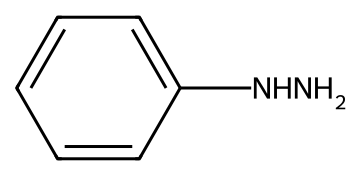
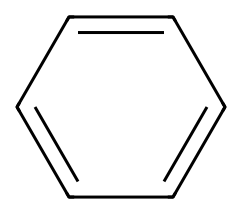
What we are solvingComplete four organic equations and give the mechanism of each(a) butanone + phenylhydrazine (acid catalyst)(b) propanal + sodium hydrogensulphite(c) ethanoyl chloride + propylamine(d) benzene + fuming sulphuric acid at 50 ∘CChapter: Organic chemistry (carbonyl compounds, acid derivatives, benzene)Topic: nucleophilic addition, addition-elimination, electrophilic substitutionConcept and formulasThe carbonyl carbon in C=O is δ+ because oxygen is more electronegative, so nucleophiles attack itAldehydes and ketones undergo nucleophilic addition (and addition-elimination with NH2 compounds)Acid chlorides undergo nucleophilic addition-elimination: Cl− is a good leaving groupBenzene has a stable delocalised π system, so it undergoes electrophilic substitution, not addition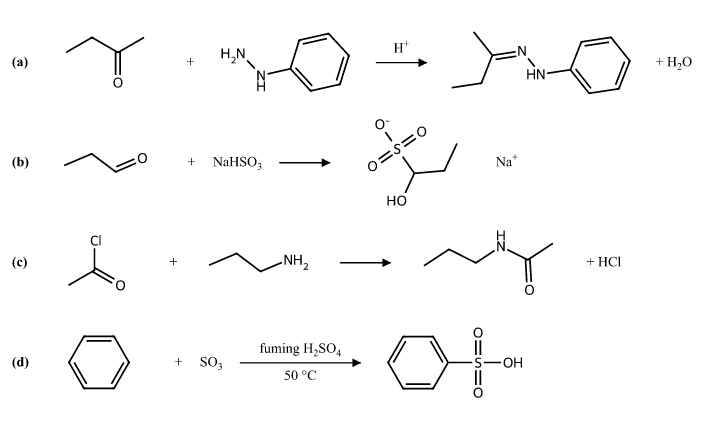 Working(a) (5½ marks)Equation (product: butanone phenylhydrazone):CH3CH2COCH3+C6H5NHNH2H+CH3CH2C(CH3)=NNHC6H5+H2OMechanism: nucleophilic addition followed by elimination of water (condensation)Step 1: H+ protonates the carbonyl oxygen, making the carbonyl carbon more positiveCH3CH2C(CH3)=O+H+→CH3CH2C+(CH3)−OHStep 2: the lone pair on the terminal NH2 nitrogen of phenylhydrazine attacks the carbonyl carbonCH3CH2C+(CH3)OH+H2NNHC6H5→CH3CH2C(CH3)(OH)−N+H2NHC6H5Step 3: loss of H+ from nitrogen and gain of H+ by the OH group→CH3CH2C(CH3)(O+H2)−NHNHC6H5Step 4: water leaves and the nitrogen lone pair forms the C=N double bond; H+ is lost (catalyst regenerated)→CH3CH2C(CH3)=NNHC6H5+H2O+H+The product is a yellow-orange crystalline solid (2,4-dinitrophenylhydrazine reacts the same way)(b) (5½ marks)Equation (product: the hydrogensulphite addition compound, a white crystalline solid):CH3CH2CHO+NaHSO3→CH3CH2CH(OH)SO3−Na+Mechanism: nucleophilic additionStep 1: the hydrogensulphite ion is the nucleophile; the lone pair on sulphur attacks the δ+ carbonyl carbon and the π electrons move onto oxygenCH3CH2Cδ+H=Oδ−+−SO3H→CH3CH2CH(O−)−SO3HStep 2: proton transfer from the SO3H group to the alkoxide oxygen (the acid medium supplies H+)CH3CH2CH(O−)SO3H→CH3CH2CH(OH)SO3−Step 3: the anion pairs with Na+: CH3CH2CH(OH)SO3−Na+(c) (4½ marks)Equation (product: N-propylethanamide):CH3COCl+CH3CH2CH2NH2→CH3CONHCH2CH2CH3+HCl(With excess amine, the HCl forms CH3CH2CH2NH3+Cl−)Mechanism: nucleophilic addition-eliminationStep 1: the lone pair on the amine nitrogen attacks the δ+ carbonyl carbon; the π electrons move to oxygenCH3Cδ+OCl+:NH2R→CH3C(O−)(Cl)−N+H2R(R=CH2CH2CH3)Step 2: the oxygen lone pair re-forms C=O and the chloride ion leaves→CH3CO−N+H2R+Cl−Step 3: the chloride ion (or a second amine molecule) removes a proton from nitrogenCH3CON+H2R+Cl−→CH3CONHR+HCl(d) (4½ marks)Equation (product: benzenesulphonic acid):C6H6+SO3fuming H2SO450 ∘CC6H5SO3H(or C6H6+H2SO4→C6H5SO3H+H2O)Mechanism: electrophilic substitution; the electrophile is sulphur trioxideStep 1: formation of the electrophile (fuming sulphuric acid contains dissolved SO3; it also forms in the acid)2H2SO4⇌SO3+H3O++HSO4−In SO3, sulphur carries a large δ+ charge (three electronegative oxygens)Step 2: the π electrons of benzene attack the sulphur atom, giving a carbocation (arenium ion) in which delocalisation is partly lostC6H6+SO3→[C6H6SO3] (intermediate: C6H6+−SO3−)Step 3: HSO4− removes H+ from the carbon that carries SO3; the aromatic ring is restoredC6H6+SO3−+HSO4−→C6H5SO3−+H2SO4Step 4: the anion takes a protonC6H5SO3−+H3O+→C6H5SO3H+H2OAnswer:(a) CH3CH2C(CH3)=NNHC6H5+H2O (b) CH3CH2CH(OH)SO3−Na+(c) CH3CONHCH2CH2CH3+HCl (d) C6H5SO3HTip:In every mechanism show where each pair of electrons moves: from a lone pair or π bond to the δ+ atom
© africaexams.com
Go to Question:
Advertisements