Test Index
UACE Chemistry 2025 Paper 2 (Theory)
© africaexams.com
Question : 7
Total: 8
Solution:
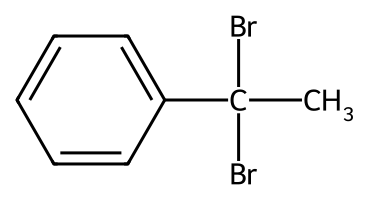
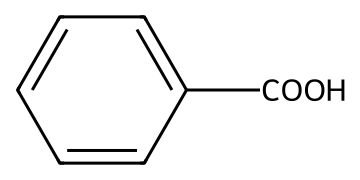
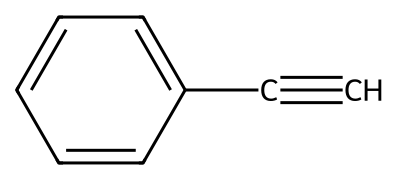
What we are solvingWrite a synthesis route, with reagents and conditions, for each target:(a) 1,1-dibromo-1-phenylethane from phenol(b) benzoic acid from aminobenzene (phenylamine)(c) propan-2-amine from 1-bromopropane(d) phenylethyne from phenylethanone(e) 2-iodopropane from propan-1-olChapter: Organic chemistryTopic: organic synthesis (interconversion of functional groups)Concept and formulasWork backwards from the target: which functional group gives it, and how is that group made from the starting material?Markovnikov rule: in addition of HX to propene, H goes to the carbon that already has more hydrogens, so X ends on the middle carbonSide-chain halogenation of an arene in UV light substitutes the benzylic hydrogens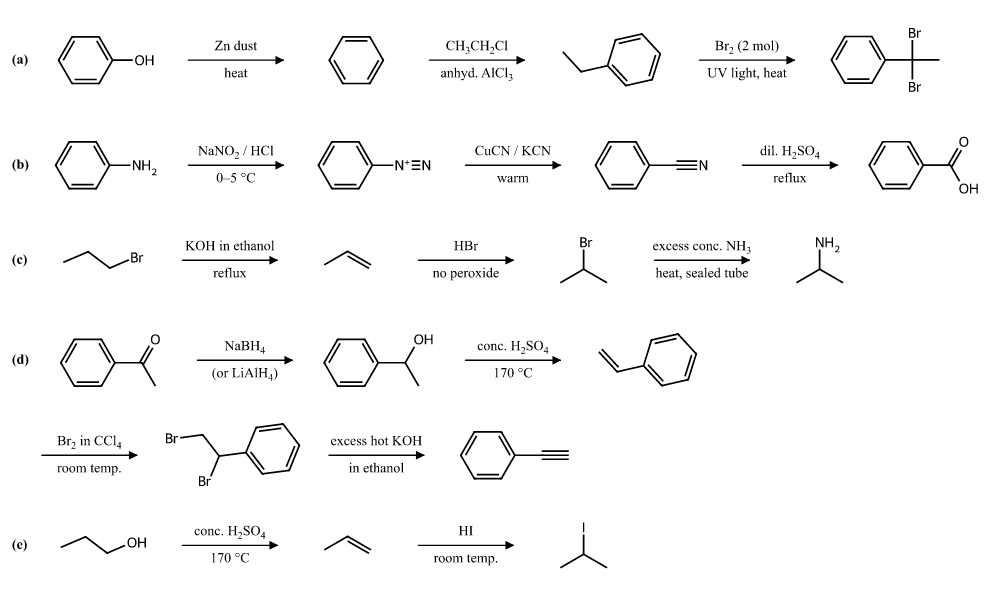 Working(a) (3 marks)Step 1: reduce phenol to benzene with zinc dust, heatC6H5OH+ZnheatC6H6+ZnOStep 2: Friedel-Crafts alkylation with chloroethane and anhydrous aluminium chloride, warmC6H6+CH3CH2Clanhyd. AlCl3C6H5CH2CH3+HClStep 3: side-chain bromination with bromine (2 mol) in UV light (or sunlight), heat; the two benzylic hydrogens are replacedC6H5CH2CH3+2Br2UV lightC6H5CBr2CH3+2HBr(b) (5 marks)Step 1: diazotisation with sodium nitrite and dilute hydrochloric acid at 0 to 5 ∘CC6H5NH2+NaNO2+2HCl0−5 ∘CC6H5N2+Cl−+NaCl+2H2OStep 2: warm with copper(I) cyanide in potassium cyanide solution (Sandmeyer reaction)C6H5N2+Cl−CuCN/KCN, warmC6H5CN+N2+Cl−Step 3: hydrolyse the nitrile by boiling under reflux with dilute sulphuric acidC6H5CN+2H2O+H+refluxC6H5COOH+NH4+(c) (5 marks)Step 1: elimination with hot concentrated potassium hydroxide in ethanol (reflux)CH3CH2CH2Br+KOHethanol, heatCH3CH=CH2+KBr+H2OStep 2: add hydrogen bromide (no peroxide) at room temperature; Markovnikov additionCH3CH=CH2+HBr→CH3CHBrCH3Step 3: heat with excess concentrated ammonia in ethanol in a sealed tubeCH3CHBrCH3+2NH3heat, sealed tubeCH3CH(NH2)CH3+NH4Br(d) (5 marks)Step 1: reduce the ketone with sodium tetrahydridoborate (or lithium tetrahydridoaluminate in dry ether)C6H5COCH3NaBH4C6H5CH(OH)CH3Step 2: dehydrate with excess concentrated sulphuric acid at about 170 ∘C (or Al2O3, heat)C6H5CH(OH)CH3conc. H2SO4, 170 ∘CC6H5CH=CH2+H2OStep 3: add bromine in tetrachloromethane at room temperatureC6H5CH=CH2+Br2→C6H5CHBrCH2BrStep 4: double dehydrobromination with excess hot concentrated potassium hydroxide in ethanol (or sodamide)C6H5CHBrCH2Br+2KOHethanol, heatC6H5C≡CH+2KBr+2H2O(Shorter route: C6H5COCH3+PCl5→C6H5CCl2CH3+POCl3, then excess hot ethanolic KOH or NaNH2)(e) (2 marks)Step 1: dehydrate propan-1-ol with excess concentrated sulphuric acid at 170 ∘CCH3CH2CH2OHconc. H2SO4, 170 ∘CCH3CH=CH2+H2OStep 2: add hydrogen iodide (concentrated hydriodic acid) at room temperature; Markovnikov additionCH3CH=CH2+HI→CH3CHICH3Answer:(a) phenol → benzene → ethylbenzene → C6H5CBr2CH3(b) → diazonium salt → C6H5CN → C6H5COOH; (c) → propene → 2-bromopropane → propan-2-amine(d) → 1-phenylethanol → phenylethene → dibromide → phenylethyne; (e) → propene → 2-iodopropaneTip:Moving a functional group from carbon 1 to carbon 2 is done through the alkene: eliminate, then add HX by Markovnikov's rule
© africaexams.com
Go to Question:
Advertisements