What we are solvingA battery company has found a rock deposit
Substance
W is a sample of the rock
W holds two salts: one dissolves in water, one does not
Together they give two cations and two anions
We must plan and carry out tests (at least 14) to identify all four ions
Chapter: Qualitative inorganic analysis
Topic: identification of cations and anions in a mixture of two salts
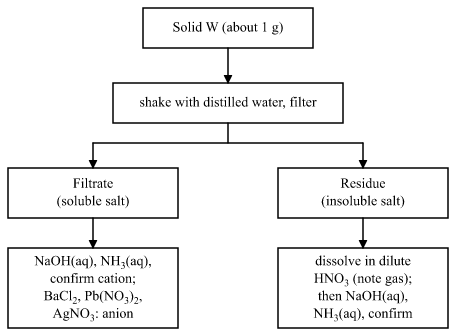
Concept and formulasWater separates the mixture: the soluble salt goes into the filtrate, the insoluble salt stays as residue
Each part is then tested on its own, so each ion can be traced to its salt
Cations are identified by the colour of their hydroxide precipitate with NaOH(aq) and NH
3(aq), and whether it dissolves in excess
Amphoteric hydroxides dissolve in excess NaOH:
Zn(OH)2(s)+2OH−(aq)→Zn(OH)42−(aq)Zinc forms an ammine complex in excess ammonia:
Zn(OH)2(s)+4NH3(aq)→Zn(NH3)42+(aq)+2OH−(aq)Anions are identified by gases with acid and by precipitates:
CO32−(s)+2H+(aq)→CO2(g)+H2O(l)Ba2+(aq)+SO42−(aq)→BaSO4(s)A confirmatory test is then done for each ion
Working: the plan1. Note the appearance of W
2. Heat a small portion; test the gases
3. Treat W with dilute acid; test the gas
4. Shake W with distilled water and filter
5. Test the filtrate (soluble salt) for its cation and anion
6. Dissolve the residue (insoluble salt) in dilute nitric acid and test for its cation
7. Confirm each ion with a specific test
Record the results in a three-column table: Test | Observation | Deduction
Working: the key to the cation testsUse this to read your NaOH and NH
3 results for the metals in Table 1
| Ion | NaOH(aq), then excess | NH3(aq), then excess |
|---|
| Mg2+ | white ppt, insoluble in excess | white ppt, insoluble in excess |
| Ca2+ | white ppt (slight), insoluble | no precipitate |
| Al3+ | white ppt, soluble in excess | white ppt, insoluble in excess |
| Zn2+ | white ppt, soluble in excess | white ppt, soluble in excess |
| Mn2+ | white ppt, insoluble, turns brown | white ppt, insoluble, turns brown |
| Fe2+ | green ppt, insoluble, turns brown | green ppt, insoluble, turns brown |
| Fe3+ | red-brown ppt, insoluble | red-brown ppt, insoluble |
| Cr3+ | grey-green ppt, soluble in excess (green solution) | grey-green ppt, insoluble |
| Ni2+ | green ppt, insoluble | green ppt, soluble in excess (blue solution) |
| Cu2+ | blue ppt, insoluble | blue ppt, soluble in excess (deep blue solution) |
Working: the testsSample observations (your own sample W may differ; deduce only what your tests show)
| No. | Test | Observation | Deduction |
|---|
| 1 | Note the appearance of W | Pale pink and white solid (a mixture) | A mixture of salts; pale pink suggests Mn2+ |
| 2 | Heat a little W strongly in a dry test tube; test any gas with lime water | Colourless droplets on the cool part; colourless gas turns lime water milky; residue yellow when hot, white when cold | Hydrated salt; CO2 from a carbonate; ZnO formed, so Zn2+ likely |
| 3 | To a little W add dilute nitric acid; test the gas with lime water | Effervescence; colourless gas turns lime water milky | CO32− present |
| 4 | Warm a little W with sodium hydroxide solution; test with moist red litmus | No gas; litmus stays red | NH4+ absent |
| 5 | Shake W with distilled water and filter. Keep filtrate (A) and residue (B) | Pale pink filtrate; white residue | One salt soluble, the other insoluble |
| 6 | To filtrate A add dilute HCl | No effervescence | Carbonate is not in the soluble salt |
| 7 | To filtrate A add NaOH(aq) dropwise, then in excess | White precipitate, insoluble in excess, turns brown on standing | Mn2+ (Mn(OH)2 oxidised in air) |
| 8 | To filtrate A add NH3(aq) dropwise, then in excess | White precipitate, insoluble in excess, darkens on standing | Mn2+ |
| 9 | To filtrate A add conc. HNO3 and a little lead(IV) oxide (or sodium bismuthate); boil, allow to settle | Purple solution | Mn2+ confirmed (oxidised to MnO4−) |
| 10 | To filtrate A add Ba(NO3)2(aq), then dilute HNO3 | White precipitate, insoluble in the acid | SO42− present |
| 11 | To filtrate A add lead(II) nitrate solution and warm | White precipitate, does not dissolve on warming | SO42− confirmed (PbCl2 would dissolve) |
| 12 | To filtrate A add dilute HNO3 then AgNO3(aq) | No observable change | Cl− absent |
| 13 | Dissolve residue B in the minimum dilute HNO3 (solution C) | Effervescence; gas turns lime water milky; colourless solution | Insoluble salt is a carbonate |
| 14 | To solution C add NaOH(aq) dropwise, then in excess | White precipitate, soluble in excess | Zn2+, Al3+ or Pb2+ |
| 15 | To solution C add NH3(aq) dropwise, then in excess | White precipitate, soluble in excess (colourless solution) | Zn2+ (Al3+ ppt would not dissolve) |
| 16 | To solution C add potassium hexacyanoferrate(II) solution | White precipitate | Zn2+ confirmed |
ConclusionFor the sample results above:
Cations:
Mn2+ and
Zn2+Anions:
SO42− and
CO32−Soluble salt: manganese(II) sulfate,
MnSO4Insoluble salt: zinc carbonate,
ZnCO3Heating and acid treatment release
CO2 (a greenhouse gas); the company should trap it (e.g. in lime water or alkali scrubbers)
Answer: Sample W:
Mn2+,
Zn2+,
SO42−,
CO32− (salts
MnSO4 and
ZnCO3)
Tip: Separate the soluble and insoluble salts first; then every test tells you which salt the ion came from