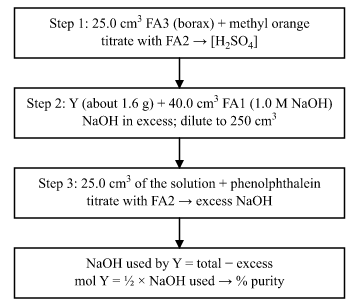
What we are solvingA food factory makes an ester from carboxylic acid Y; its flavour is inconsistent
We must find the percentage purity of Y and compare it with the range 95 – 99 %
Given: FA1 = 1.0 M NaOH (use 40 cm
3); FA2 = H
2SO
4 of unknown concentration
FA3 = 0.05 M sodium tetraborate; Y about 1.6 g, RFM = 99.8
1 mol of Y reacts with 2 mol of NaOH
Chapter: Volumetric analysis
Topic: back titration and percentage purity
Concept and formulasY does not give a sharp end point with the alkali directly, so it is reacted with a known excess of NaOH
The NaOH left over is found by titration with standardised acid; the NaOH used by Y is the difference
Standardisation of FA2 (methyl orange, because boric acid is a weak acid):
Na2B4O7(aq)+H2SO4(aq)+5H2O(l)→Na2SO4(aq)+4H3BO3(aq)Mole ratio borate : acid = 1 : 1
Reaction of Y (a dibasic acid, H
2Y):
H2Y(s)+2NaOH(aq)→Na2Y(aq)+2H2O(l)Back titration (phenolphthalein):
2NaOH(aq)+H2SO4(aq)→Na2SO4(aq)+2H2O(l)moles=1000M×VM = concentration in mol dm
−3; V = volume in cm
3% purity=mass of samplemass of pure Y×100Working: procedurePart 1, standardise FA2
1. Fill a burette with FA2
2. Pipette 25.0 cm
3 of FA3 into a conical flask; add 2 to 3 drops of methyl orange
3. Titrate with FA2 until the colour changes from yellow to orange (pink)
4. Repeat to get consistent titres (within 0.10 cm
3)
Part 2, react Y with excess NaOH
5. Weigh about 1.6 g of Y accurately by difference
6. Dissolve it in 40.0 cm
3 of FA1 (measured by burette or pipette) in a beaker; stir until no solid remains
7. Transfer the solution with washings into a 250 cm
3 volumetric flask; make up to the mark with distilled water; shake well (solution FA4)
Part 3, back titration
8. Pipette 25.0 cm
3 of FA4 into a conical flask; add 2 drops of phenolphthalein
9. Titrate with FA2 until the pink colour just disappears
10. Repeat to get consistent titres
Working: resultsSample readings (your own readings will differ)
Table 1: Standardisation of FA2 (25.0 cm3 of FA3)| Titration | Rough | 1 | 2 | 3 |
|---|
| Final burette reading / cm3 | 25.30 | 25.00 | 25.10 | 24.90 |
| Initial burette reading / cm3 | 0.00 | 0.00 | 0.00 | 0.00 |
| Volume of FA2 used / cm3 | 25.30 | 25.00 | 25.10 | 24.90 |
Average titre =
325.00+25.10+24.90=25.00 cm3Table 2: Mass of Y| Weighing | Mass / g |
|---|
| Weighing bottle + Y | 14.60 |
| Weighing bottle after emptying | 13.00 |
| Mass of Y used | 1.60 |
Table 3: Back titration (25.0 cm3 of FA4)| Titration | Rough | 1 | 2 | 3 |
|---|
| Final burette reading / cm3 | 9.40 | 9.20 | 18.45 | 27.60 |
| Initial burette reading / cm3 | 0.00 | 0.00 | 9.20 | 18.45 |
| Volume of FA2 used / cm3 | 9.40 | 9.20 | 9.25 | 9.15 |
Average titre =
39.20+9.25+9.15=9.20 cm3Working: calculationsStep 1: moles of borate in 25.0 cm
3 of FA3
10000.05×25.0=1.25×10⁻³ molStep 2: moles of H
2SO
4 in 25.00 cm
3 of FA2 (ratio 1 : 1) =
1.25×10⁻³ mol
[H2SO4]=25.001.25×10−3×1000=0.0500 mol dm−3Step 3: moles of H
2SO
4 in the back titre
10000.0500×9.20=4.60×10⁻⁴ molStep 4: excess NaOH in 25.0 cm
3 of FA4 (ratio 2 : 1)
2×4.60×10−4=9.20×10⁻⁴ molStep 5: excess NaOH in 250 cm
39.20×10−4×25.0250=9.20×10⁻³ molStep 6: total NaOH added (40.0 cm
3 of 1.0 M)
10001.0×40.0=0.0400 molStep 7: NaOH that reacted with Y
0.0400−0.00920=0.0308 molStep 8: moles of Y (ratio Y : NaOH = 1 : 2)
20.0308=0.0154 molStep 9: mass of pure Y
0.0154×99.8=1.537 gStep 10: percentage purity
1.601.537×100=96.1 %ConclusionWith the sample readings, Y is 96.1 % pure
This lies within the recommended range of 95 – 99 %
Use your own readings in the same steps; compare your answer with 95 – 99 % in the same way
Answer: Percentage purity of Y = 96.1 % (sample readings); within 95 – 99 %
Tip: In a back titration, always find the excess first, then subtract it from the total added