What we are solvingSection A: five short two-part items, each worth 4 marks
(a) cross elasticity of demand: definition and a calculation from given prices and quantities
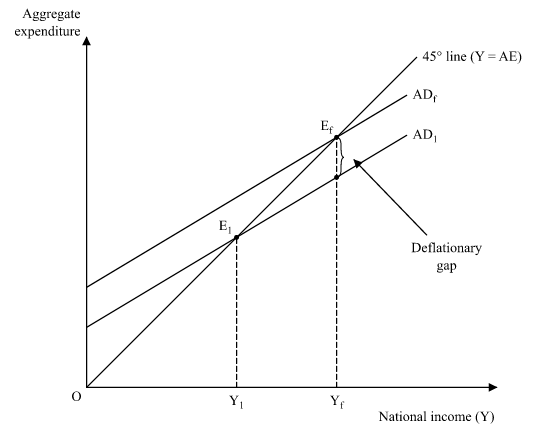
(b) the deflationary gap and its effects
(c) private and public foreign capital
(d) imported and cost-push inflation, and control of imported inflation
(e) Value Added Tax and Capital Gains Tax
Chapter: Price theory; National income; Development economics; Money and inflation; Public finance
Topic: elasticity of demand, Keynesian gaps, foreign capital, inflation, taxation
Key ideasCross elasticity links the demand for one good to the price of another
Its sign tells the relationship: positive for substitutes, negative for complements
A gap is measured at the full employment income level
YfDirect taxes fall on income or wealth; indirect taxes fall on spending
Model answer(a)(i) (1 mark)Cross elasticity of demand is the degree of responsiveness of the quantity demanded of one commodity to a change in the price of another commodity
(a)(ii) (3 marks)Formula
XED=ΔPxΔQy×QyPxGiven
Px: Shs 2,780 to Shs 3,250
Qy: 410 kgs to 485 kgs per week
Changes
ΔPx=3250−2780=470ΔQy=485−410=75Substitute (original values
Px=2780,
Qy=410)
XED=47075×4102780XED=192700208500XED≈+1.08Check with percentages
%ΔQy=41075×100=18.29%%ΔPx=2780470×100=16.91%16.9118.29=1.08The sign is positive: a rise in the price of X raised the demand for Y
So X and Y are substitutes (competitive demand)
(b)(i) (1 mark)A deflationary gap is the amount by which aggregate expenditure falls short of the level required to achieve full employment national income
In the diagram it is the vertical distance between
ADf and
AD1 at
YfActual equilibrium is at
Y1, below full employment income
Yf(b)(ii) (3 marks)Any three of these
1. Unemployment rises, since firms cut output when spending is low
2. Output and national income fall below the full employment level
3. The general price level falls (deflation)
4. Firms make low profits or losses; some close down
5. Investment falls, which slows economic growth
6. Government tax revenue falls
7. Standards of living fall as incomes drop
(c)(i) (2 marks)Private foreign capital is capital that comes from private individuals and firms abroad, mainly for profit, e.g. foreign direct investment and portfolio investment
Public foreign capital is capital that comes from foreign governments and international institutions (World Bank, IMF, AfDB), as loans, grants and technical assistance
(c)(ii) (2 marks)Any two of these
1. Bilateral loans and grants (government to government)
2. Multilateral loans and grants (World Bank, IMF, African Development Bank)
3. Technical assistance (experts, training, equipment)
4. Food aid and humanitarian relief
5. Debt relief or debt cancellation
6. Tied aid (aid spent on goods from the donor country)
(d)(i) (2 marks)Imported inflation is a persistent rise in the general price level caused by importing goods and inputs from countries whose prices are rising, or by a fall in the value of the local currency
Cost-push inflation is a persistent rise in the general price level caused by rising costs of production inside the economy, such as higher wages, raw material prices, taxes or interest rates
Imported inflation starts outside the economy; cost-push inflation starts in the producers' own costs
(d)(ii) (2 marks)Any two of these
1. Stabilise the exchange rate (stop the shilling depreciating), e.g. Bank of Uganda selling foreign exchange
2. Produce import substitutes locally to cut dependence on imports
3. Reduce import duties or give subsidies on essential imported inputs such as fuel
4. Diversify import sources towards cheaper suppliers
5. Build strategic reserves (e.g. fuel) to cushion sudden world price rises
(e)(i) (2 marks)Value Added Tax is an indirect tax charged on the value added at each stage of production and distribution, finally paid by the consumer (18% in Uganda)
Capital Gains Tax is a direct tax charged on the gain (profit) made from selling or disposing of a capital asset such as land, buildings or shares
(e)(ii) (2 marks)Any two of these
1. To raise government revenue from a broad base
2. It is hard to evade: each trader claims credit only with invoices, so traders check each other
3. It avoids the cascading (tax on tax) of the old sales tax
4. To discourage consumption of luxuries and encourage saving
5. To widen the tax net to include the informal and service sectors
Answer: XED = +1.08 (X and Y are substitutes); the deflationary gap is the shortfall of aggregate expenditure below the full employment level
Tip: Always state the sign of a cross elasticity and what it says about the two goods