What we are solvingSection A: ten short parts on markets, saving, unemployment, inflation and commercial policy
Each part needs a precise definition or the exact number of points asked, nothing more
Chapter: Price theory; National income; Unemployment; Inflation; International trade
Topic: markets, saving, frictional unemployment, inflation, commercial policy
Key ideasA distinction must show both terms side by side (one sentence each)
"Give two" / "State three" earns one mark per correct, distinct point
Model answer(a)(i) (2 marks)A
commodity market is a market where final goods and services are bought and sold, e.g. Owino market in Kampala selling clothes and food
A
factor market is a market where factors of production (land, labour, capital, entrepreneurship) are bought and hired, e.g. the labour market or the land market
(a)(ii) (2 marks) (any two)
1. The forces of demand and supply of the commodity
2. The cost of production (e.g. fuel, raw materials, taxes)
3. Government policy: price controls, taxes and subsidies
4. The degree of competition / market structure (monopoly or many sellers)
5. Bargaining power of buyers and sellers
(b)(i) (2 marks)Marginal propensity to save (MPS) is the ratio of the change in saving to the change in income
MPS=ΔYΔSAverage propensity to save (APS) is the ratio of total saving to total income
APS=YS(b)(ii) (2 marks) (any two)
1. Level of income: higher incomes raise the MPS
2. Interest rate on savings
3. Availability and nearness of financial institutions (banks, SACCOs)
4. The price level / rate of inflation
5. Saving culture and size of the family (dependants)
(c)(i) (1 mark)Frictional unemployment is temporary unemployment that arises when workers are moving from one job to another or are searching for jobs, because of imperfect knowledge of job openings and immobility of labour
(c)(ii) (3 marks) (any three)
1. Improving labour market information, e.g. job centres, newspaper and online job adverts
2. Improving transport and communication to raise geographical mobility of labour
3. Providing housing / social amenities in areas with job openings
4. Retraining and skilling workers to improve occupational mobility
5. Simplifying and speeding up recruitment procedures
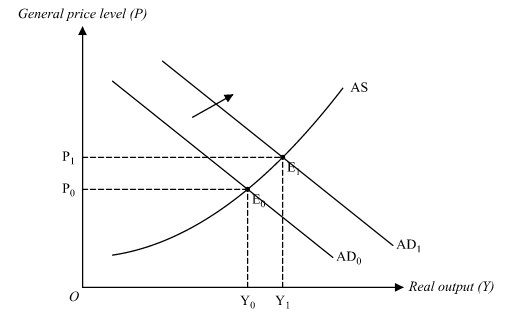
(d)(i) (2 marks)Demand pull inflation is a persistent rise in the general price level caused by aggregate demand exceeding aggregate supply at full or near full employment (too much money chasing too few goods)
Structural inflation is a persistent rise in the general price level caused by structural rigidities in the economy, e.g. poor infrastructure, low supply response of agriculture and bottlenecks in production
Demand pull: aggregate demand rises from
AD0 to
AD1, so the price level rises from
P0 to
P1(d)(ii) (2 marks) (any two)
1. Restrictive monetary policy: raising the Central Bank Rate, selling securities (open market operations), raising the reserve requirement
2. Restrictive fiscal policy: raising direct taxes and cutting government expenditure
3. Wage restraint / income policy
4. Encouraging saving to reduce consumption spending
(e)(i) (1 mark)Commercial policy is the set of government measures used to influence the volume, direction and composition of a country's foreign trade, e.g. tariffs, quotas, export promotion and exchange controls
(e)(ii) (3 marks) (any three)
1. To correct balance of payments deficits
2. To protect infant (domestic) industries
3. To raise government revenue through import and export duties
4. To promote exports and diversify the export base
5. To discourage the importation of harmful goods (dumping and unsafe products)
6. To create employment and promote self-sufficiency
Answer: commodity vs factor market; price determinants; MPS = ΔS/ΔY vs APS = S/Y; frictional unemployment and its cures; demand pull vs structural inflation; commercial policy and its objectives
Tip: In Section A give exactly the number of points asked; extra points earn nothing and waste time