Test Index
UACE Economics 2024 Paper 2
© africaexams.com
Question : 2
Total: 7
Solution:
What we are solving(a) explain how capital helps Uganda develop (8 marks)(b) examine what decides the rate of capital accumulation in Uganda (12 marks)Chapter: Economic growth and developmentTopic: capital, capital formation (accumulation)Key ideasCapital is man-made wealth used to produce further wealth, e.g. machines, roads, buildings, toolsCapital accumulation (capital formation) is the process of increasing the stock of real capital in a country over timeIt is financed by saving: saving → investment → more capital → more outputEconomic development: growth in real output plus structural change and a better standard of livingModel answer(a) (8 marks)Introduction: capital is man-made wealth used in further production1. Raises output and economic growthMore machines and equipment raise GDP; the production possibility frontier shifts outwards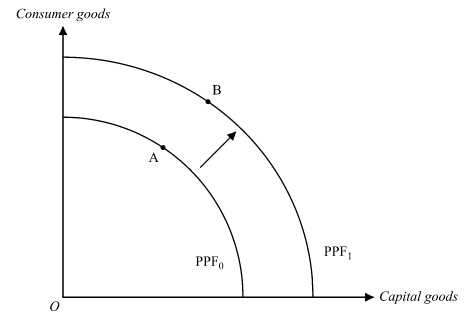 Capital accumulation moves the economy from PPF0 to PPF1, so it can reach B instead of A2. Increases labour productivityWorkers with tractors, tools and machines produce more per head, e.g. mechanised farming in Kiryandongo3. Creates employmentNew factories and projects employ workers, e.g. industrial parks at Namanve4. Promotes industrialisation and structural changeCapital allows the economy to move from subsistence agriculture to manufacturing5. Improves infrastructureRoads, power dams (Karuma, Isimba) and railways cut production costs and open up markets6. Improves quality and diversity of outputModern machines produce better, standardised goods for export7. Helps exploit idle resourcesCapital equipment is needed to exploit oil in the Albertine region and minerals8. Improves social welfareSocial capital such as schools and hospitals raises human capital and living standards(b) (12 marks)Introduction: capital accumulation depends on the ability and the willingness to save and invest1. Level of incomeLow per capita income gives a low capacity to save, so little investment; higher incomes raise savings2. Rate of interestHigh lending rates in Uganda discourage borrowing for investment; high deposit rates encourage saving3. Development of financial institutionsBanks, SACCOs and mobile money mobilise savings; their absence in rural areas limits capital formation4. Political climate and securityPeace attracts both local and foreign investment; insecurity scares investors5. Size of the marketA large market (EAC, COMESA) gives investors an incentive to expand capacity6. Level of infrastructureGood roads, power and water lower costs and attract investment7. Government policyTax holidays, investment incentives by the Uganda Investment Authority and liberal policies encourage investment8. InflationHigh and unstable prices discourage saving and long-term investment9. Availability of foreign capital (aid, loans, FDI)Foreign direct investment, e.g. in oil and telecommunications, adds to domestic capital10. Entrepreneurial skills and technologySkilled entrepreneurs and appropriate technology raise the willingness to invest11. Consumption pattern / demonstration effectHigh conspicuous consumption of imports reduces savings12. Capital flight and corruptionEmbezzled funds and profits repatriated abroad reduce domestic capitalConclusionCapital is the engine of Uganda's growth: it raises output, employment and productivityIts accumulation is limited mainly by low incomes and savings, high interest rates and weak financial institutions, so policy should raise savings and investment incentivesAnswer: (a) capital raises output, productivity, employment, industrialisation and infrastructure; (b) income, interest rates, financial institutions, security, market size, infrastructure, government policy, inflation, foreign capital, entrepreneurshipTip: In (a) say how each point helps development; in (b) each factor can work for or against accumulation
© africaexams.com
Go to Question:
Advertisements