Test Index
UACE Economics 2025 Paper 1
© africaexams.com
Question : 7
Total: 7
Solution:
What we are solving(a) Separate tariffs from non-tariff barriers to trade (4 marks)(b) Weigh the good and bad effects of protecting the domestic economy from foreign trade (16 marks)Chapter: International tradeTopic: trade protectionism; tariff and non-tariff barriersKey ideasProtectionism: deliberate government restriction of imports to shield domestic industries from foreign competitionA tariff raises the domestic price of the import from Pw to Pw+t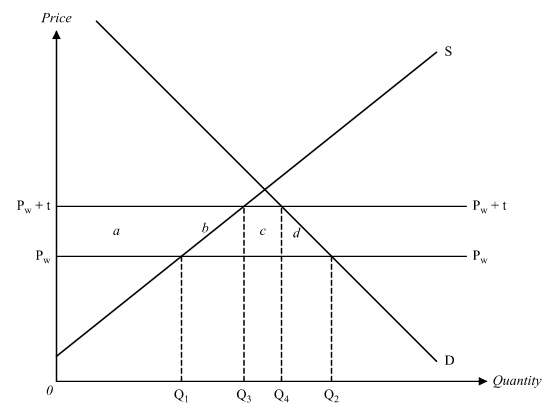 Domestic output rises from Q1 to Q3; consumption falls from Q2 to Q4; imports fall from Q1Q2 to Q3Q4Area a: gain to domestic producers; area c: tariff revenue to government; areas b and d: deadweight (efficiency) loss; consumers lose a+b+c+dModel answer(a) (4 marks)A tariff barrier is a tax (customs duty) imposed on imported goods to raise their prices and so reduce imports, e.g. the EAC Common External Tariff of 25% on finished goodsNon-tariff barriers are restrictions on imports other than taxes, e.g. import quotas, import bans (embargoes), import licensing, foreign exchange controls, strict quality and health standards, and administrative delaysDifference: a tariff works through price and earns revenue for the government; non-tariff barriers work mainly by limiting the quantity of imports and usually earn no revenue(b) (16 marks)Introduction: trade protectionism is the restriction of free trade by tariff and non-tariff barriers to protect domestic producersPositive effects1. Protects infant industriesYoung local industries grow behind the barriers until they can compete, e.g. Uganda's steel and sugar industries2. Creates employmentExpanded domestic production (output Q1→Q3) creates jobs3. Improves the balance of paymentsFewer imports reduce foreign exchange outflow4. Raises government revenueTariffs earn customs revenue (area c)5. Prevents dumpingBarriers stop cheap, often low-quality goods sold below cost by foreign firms from destroying local industries6. Promotes self-reliance and protects strategic industriesFood, energy and defence industries are kept at home for security7. Discourages consumption of harmful (demerit) goodsBans and high duties reduce imports of second-hand clothes, narcotics or harmful products8. Encourages diversification and use of local resourcesLocal raw materials are processed at home instead of importing finished goodsNegative effects9. Higher prices for consumersConsumers pay Pw+t instead of Pw and consume less, reducing their welfare10. Inefficiency of protected firmsWithout foreign competition firms become complacent, producing high-cost, low-quality goods11. Loss of benefits of specialisationResources are pulled into industries where the country has no comparative advantage, giving deadweight losses (areas b and d)12. Retaliation by trading partnersOther countries impose barriers on the country's exports, reducing export earnings13. Smuggling and corruptionHigh duties and bans encourage smuggling across borders and bribery of customs officials, lowering revenue14. Reduced choice and varietyConsumers have fewer goods to choose from15. Conflicts with regional integrationBarriers go against EAC and COMESA free-trade commitments and cause trade disputes16. Higher costs for local industriesDuties on imported inputs and machinery raise production costsConclusionProtectionism helps a developing economy in the short run by nurturing infant industries, raising revenue and saving foreign exchangeIn the long run, if prolonged, its costs (high prices, inefficiency, retaliation and smuggling) outweigh the benefits; protection should be selective and temporaryAnswer: (a) tariff = tax on imports (works through price, earns revenue); non-tariff barriers = quotas, bans, licences, exchange controls, standards (limit quantity, no revenue)(b) positive: infant industries, jobs, BoP, revenue, anti-dumping, self-reliance, fewer demerit goods, diversification; negative: high prices, inefficiency, lost specialisation, retaliation, smuggling, less variety, conflict with integration, higher input costsTip: "Assess" needs both sides and a judgement; give both positive and negative effects
© africaexams.com
Go to Question:
Advertisements