Test Index
UACE Geography 2023 Paper 3 (Uganda and Fieldwork)
© africaexams.com
Question : 3
Total: 8
Solution:
What we are solvingWe must judge how far altitude (height above sea level) controls Uganda's climate (temperature, rainfall, humidity),and show the other factors that also influence it.Chapter: Uganda: climateTopic: Factors influencing the climate of UgandaKey ideasClimate is the average weather of a place over a long period (about 30 years).Temperature falls with height at about 0.6∘C per 100 m (the normal lapse rate).Uganda lies astride the equator (about 1∘S to 4∘N) and mostly on a plateau of about 900 to 1,500 m, so its climate is a modified equatorial climate.Highlands: Rwenzori (Margherita Peak 5,109 m), Mt Elgon (Wagagai 4,321 m), Kigezi highlands, Mt Moroto; lowlands: Albertine rift floor (Lake Albert about 620 m).Model answerIntroduction: Uganda has a tropical climate with high temperatures, two rainy seasons in the south and one in the north; altitude is a major control, together with latitude, water bodies, winds and vegetation.Ways in which altitude has influenced the climate1. Low temperatures in highland areas.Temperature falls with height, so Kabale and the Kigezi highlands have cool means of about 17 to 18 °C, compared with about 22 °C at Kampala.The summits of Rwenzori carry permanent snow and glaciers even on the equator.2. High temperatures in lowland areas.The low rift-valley floor around Lake Albert, Pakwach and Kasese is hot, with temperatures above 25 °C and high evaporation.3. Heavy relief rainfall on windward slopes.Moist winds forced up Mt Elgon, Rwenzori and the Kigezi highlands cool, condense and give heavy rainfall (often over 1,500 mm a year), e.g. Bududa, Sironko and Bundibugyo.4. Rain-shadow (leeward) dry areas.Descending air on the leeward sides warms and dries, e.g. the drier rift floor around Kasese in the lee of the Rwenzori.5. Moderate (pleasant) temperatures on the central plateau.Most of Uganda is a plateau of 900 to 1,500 m, so it is cooler than other equatorial lowlands (such as the Congo basin); hence a modified equatorial climate.6. Frost and mist at high altitude.Highlands have cold nights, frost and morning mist, e.g. Kabale and the upper slopes of Elgon.7. Low evaporation and high humidity in the highlands.Cool temperatures reduce evaporation, keeping the air damp and the ground wet for long periods.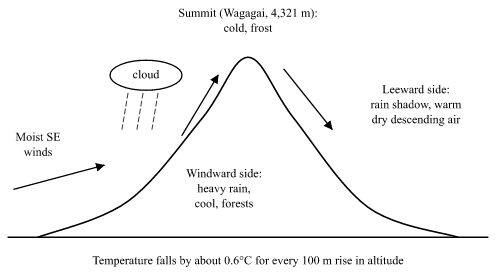 Other factors that have influenced the climate1. Latitude (position astride the equator).The overhead sun gives high temperatures all year with a small annual range; the movement of the ITCZ gives two rainy seasons (March to May, September to November) in the south and one long season in the north.2. Large water bodies.Lake Victoria gives lake breezes and heavy convectional rainfall to its shores and islands (Entebbe, Kalangala, Jinja), and moderates temperatures.3. Prevailing winds.Dry north-east trade winds from the Sahara/Arabia cause the long dry season and semi-arid conditions of Karamoja; moist south-east trades and Congo air bring rain to the south and west.4. Vegetation cover.Forests such as Mabira, Budongo and Bwindi add moisture by evapotranspiration and favour local rainfall; deforestation reduces it.5. Human activities.Clearing forests and draining swamps, urbanisation (Kampala heat island) and air pollution alter local temperature and rainfall.6. Distance from the sea (continentality).Uganda is far inland, so the drying effect of distance is seen in the north-east.ConclusionAltitude has influenced Uganda's climate to a large extent: it explains the cool highlands, hot lowlands, relief rainfall and rain-shadow areas, and the modified equatorial climate of the plateau.However, latitude, Lake Victoria, prevailing winds, vegetation and human activities also strongly influence rainfall amount and seasons, so altitude is the main but not the only factor.Answer: To a large extent: altitude controls temperature and relief rainfall, but latitude, lakes, winds, vegetation and human activities also shape Uganda's climate.Tip: In a 'to what extent' essay, give the factor in the question first, then the other factors, and end with a clear judgement.
© africaexams.com
Go to Question:
Advertisements