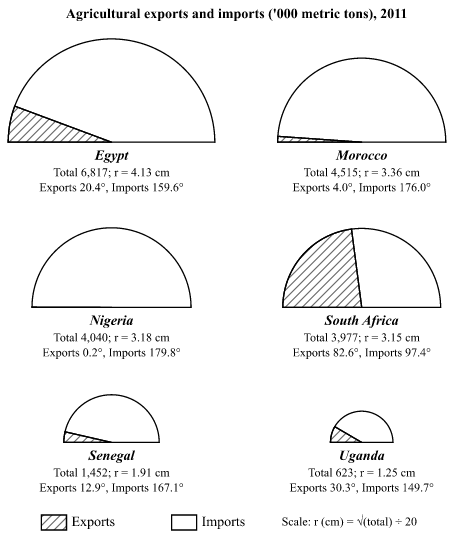
Adapted: African Development Indicators 2012/13 World Bank Page 92.(a) Draw proportional divided semi-circles to portray the information in the table. (12 marks)(b) Outline the advantages of using the above statistical method. (03 marks)(c) With reference to the table and the diagram, explain the pattern of export and import trade of the selected African countries. (04 marks)(d) Examine the challenges facing international trade in Africa. (06 marks)
What we are solvingThe table gives agricultural exports and imports (‘000 metric tons) of six African countries in 2011(a) Draw proportional divided semi-circles: size shows total trade, the two parts show exports and imports(b) Give the advantages of the method(c) Explain the trade pattern shown(d) Examine the challenges of international trade in AfricaChapter: Statistical methods; International tradeTopic: Proportional divided semi-circles; trade of African countriesKey ideasA proportional divided semi-circle is a half circle whose area is proportional to a totalSo the radius is proportional to the square root of the totalr=ktotalA semi-circle has 180∘, so each part gets an angle:angle=totalpart×180∘(a) (12 marks)Step 1: totals (exports + imports) for each countrye.g. Egypt: 774+6043=6817Step 2: square roots, e.g. 6817=82.57Step 3: choose a scale so the largest semi-circle fits on the pageScale: r(cm)=total÷20Egypt: 82.57÷20=4.13 cmStep 4: angles, e.g. Egypt exports =6817774×180∘=20.4∘Egypt imports =180∘−20.4∘=159.6∘
Country
Total trade (‘000 t)
total
Radius (cm)
Exports angle
Imports angle
Nigeria
4,040
63.56
3.18
0.2
179.8
Senegal
1,452
38.11
1.91
12.9
167.1
Uganda
623
24.96
1.25
30.3
149.7
Egypt
6,817
82.57
4.13
20.4
159.6
Morocco
4,515
67.19
3.36
4.0
176.0
South Africa
3,977
63.06
3.15
82.6
97.4
Step 5: draw each semi-circle on a straight base line with its radiusMark the exports angle from the left end of the base with a protractor; shade itLeave the imports part plain; name each country below; add a key, a scale and a titleNigeria's exports (0.2∘) are too small to show; write the value beside it
(b) (03 marks)1. Shows two things at onceThe size shows total trade and the divisions show exports and imports2. Easy comparison between countriesEgypt's large semi-circle and Uganda's small one stand out at a glance3. Easy to see the share of each partSouth Africa's large shaded part shows its nearly balanced trade4. Square roots allow a big range of valuesTotals from 623 to 6,817 fit on one page5. Attractive and easy to readEven a person without statistical skills can interpret it(c) (04 marks)Pattern: imports are far greater than exports in every countryTotal imports 18,512 against exports 2,912 thousand tons; Africa is a net importer of agricultural productsEgypt has the largest volume of trade (6,817) and Uganda the smallest (623)South Africa has the most balanced trade and the largest exports (1,824)Nigeria exports almost nothing (5) but imports 4,035Reasons:Large and fast-growing urban populations (Lagos, Cairo) need more food than local farms produceDesert climates in Egypt and Morocco limit farming to irrigated land, so wheat is importedNigeria's oil economy drew labour and investment away from farmingSouth Africa has commercial, mechanised farms (fruit, wine, maize) that produce a surplus for exportUganda is largely self-sufficient in food, so it imports little; its trade is small(d) (06 marks)1. Export of raw materials of low valueCoffee, cocoa and cotton earn little while manufactured imports are dear: poor terms of trade2. Price fluctuations on the world marketFalls in coffee or copper prices cut export earnings3. Similar products among African countriesNeighbours grow the same crops, so trade among them is small4. Poor transport and communicationFew railways link countries; landlocked Uganda depends on Mombasa and Dar es Salaam5. Trade barriers and protectionismQuotas, tariffs and strict standards in the EU and USA limit African exports6. Competition from developed countriesSubsidised farm products and cheap Chinese goods undercut local producers7. Political instability and conflictWars in South Sudan and DR Congo disrupt trade routes8. Shortage of capital and foreign exchangeTraders cannot finance large consignments; debts eat export earnings9. Non-tariff barriers within blocsRoad blocks, delays at borders such as Malaba and Busia raise costsConclusionAfrica's agricultural trade is small and heavily in deficit, and its growth is held back by low-value exports, poor transport and trade barriersAnswer: Radii total÷20 cm (Egypt 4.13 cm largest, Uganda 1.25 cm smallest); imports exceed exports everywhereTip: Always use the square root for proportional circles; check the two angles add to 180∘