Test Index
UACE Geography 2024 Paper 3 (Uganda and Fieldwork)
© africaexams.com
Question : 3
Total: 8
Solution:
What we are solving(a) Describe what savanna vegetation looks like and its features (10 marks)(b) Explain the conditions in Uganda that have favoured its growth (15 marks)Chapter: Uganda: vegetationTopic: Savanna vegetation in UgandaKey ideasSavanna is tropical grassland with scattered trees; it covers most of UgandaTypes in Uganda: moist (wooded) savanna in Buganda, Busoga, West Nile and AcholiDry savanna and thorn bush in Karamoja, Teso and the Ankole-Masaka (cattle) corridorFound in national parks such as Murchison Falls, Queen Elizabeth, Kidepo Valley and Lake Mburo(a) Characteristics (10 marks)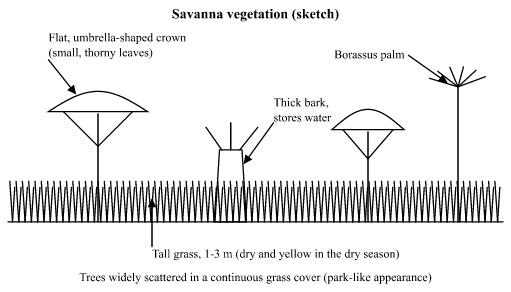 1. Tall grasses dominateElephant grass and spear grass grow 1-3 m tall, e.g. in Buganda and Bunyoro2. Trees are scatteredTrees stand far apart in the grass, giving a park-like appearance, e.g. Queen Elizabeth NP3. Umbrella-shaped crownsAcacia trees have flat-topped crowns that shade their roots, e.g. Lake Mburo NP4. Small, thorny or waxy leavesThey reduce water loss by transpiration in the dry season5. Deciduous treesMost trees shed their leaves in the dry season to save water6. Thick barksThick bark protects the trees from fire and stores water, e.g. the baobab in Karamoja7. Long and deep rootsThey reach underground water in the dry season8. Seasonal change in colourGrass is green in the wet season and dries up yellow-brown in the dry season9. Few tree speciesMainly acacia, combretum, shea-nut (in the north) and Borassus palms10. Fire-resistant plantsGrasses regrow from underground roots after burning(b) Conditions favouring savanna in Uganda (15 marks)1. Tropical wet and dry climateRainfall of about 750-1,500 mm a year with one or two dry seasonsToo little and too seasonal for forest, enough for tall grass, e.g. Teso and Lango2. High temperaturesMean temperatures of about 20-30 °C cause high evaporationPlants must store water and shed leaves, which suits grass and drought-resistant trees3. Long dry season in the north-eastKaramoja has a long dry season and low rainfall (about 500-750 mm)This favours dry thorn-bush savanna4. Rain-shadow areasLeeward areas receive less rain, e.g. the Kasese lowlands east of the Rwenzori and the dry Ankole-Masaka corridorForest cannot grow there; grassland develops5. Porous, leached soilsFerrallitic and sandy soils drain quickly and lose nutrientsThey support grass better than dense forest6. Gently undulating plateau reliefMost of Uganda is a plateau at about 900-1,500 mThe open land is suited to grassland7. Bush burningFarmers and pastoralists burn grass to get fresh pasture and to huntFire kills tree seedlings and favours fire-resistant grasses8. Grazing by livestock and wild animalsCattle in Ankole and Karamoja, and elephants, buffaloes and antelopes in parksThey destroy young trees and keep the land open9. Human clearing of forestsCultivation, charcoal burning and settlement have replaced forest with derived savannae.g. parts of Buganda and Bunyoro10. Government policy of gazetting parks and reservesMurchison Falls, Queen Elizabeth, Kidepo Valley and Lake Mburo protect savanna ecosystemsThis preserves large savanna areas11. Low population density in some areasLarge areas in the north and north-east have few peopleNatural savanna is left undisturbedConclusionSavanna is grassland with scattered, drought- and fire-resistant treesIt is favoured in Uganda mainly by the seasonal climate, helped by soils, relief, fire, grazing and human activityAnswer:(a) tall grass, scattered umbrella-shaped deciduous trees, thick bark, deep roots, thorny leaves, seasonal colour change(b) seasonal rainfall, high temperatures, dry seasons and rain shadow, leached soils, plateau relief, burning, grazing, clearing, gazetted parksTip:In part (b) always link each condition to the vegetation: say how it favours grass or limits trees
© africaexams.com
Go to Question:
Advertisements