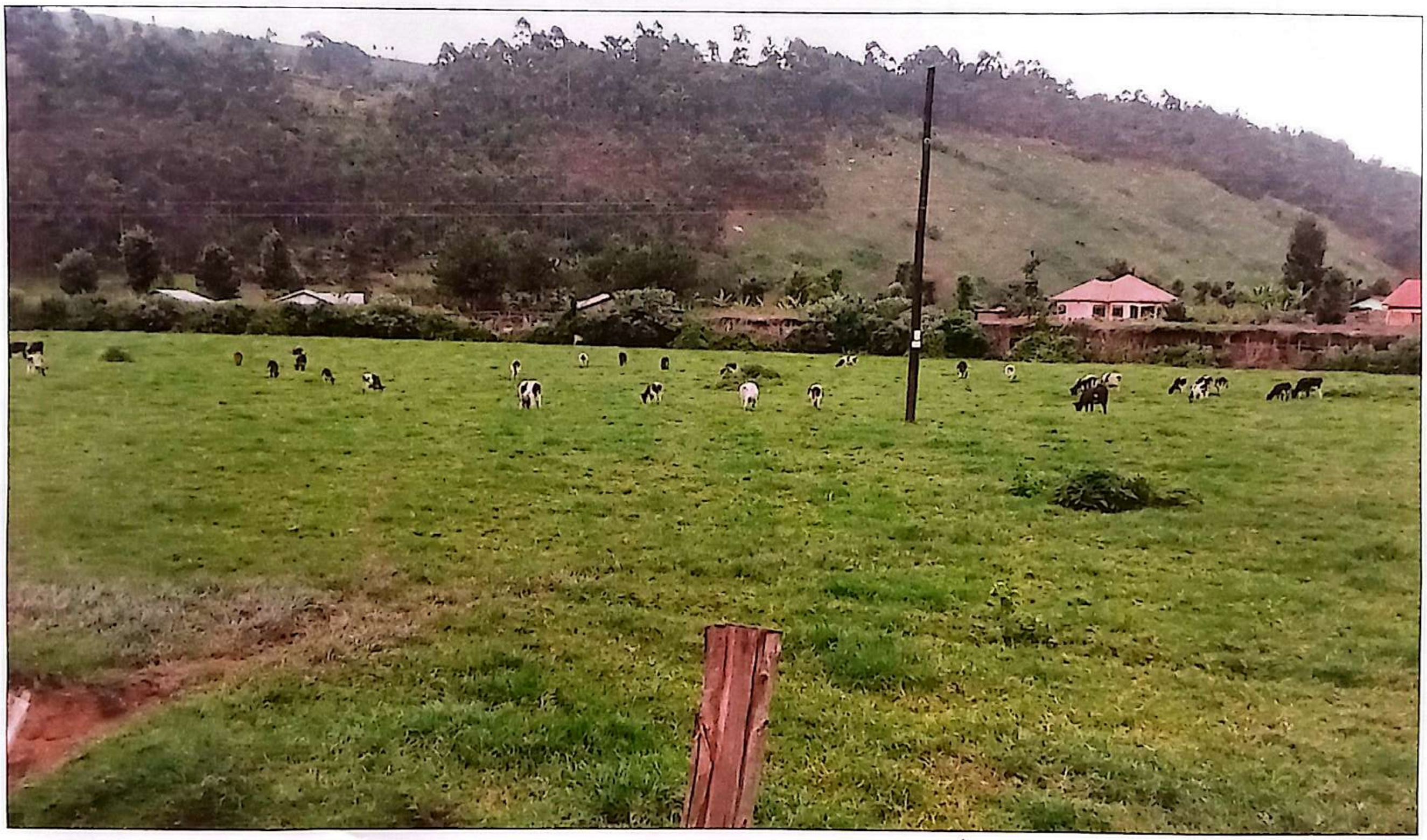
What we are solvingA photograph of a flat green pasture with black-and-white (exotic) cattle in front of houses, a power line and a hill
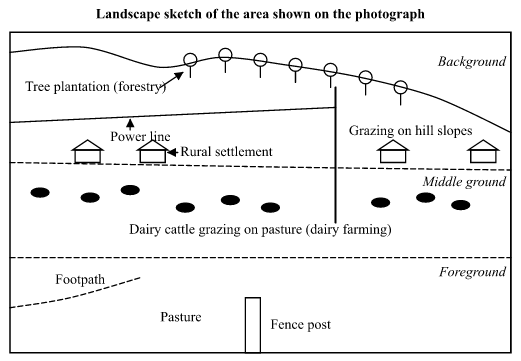
covered with tall (eucalyptus) trees and grass. We sketch it, explain why the activity (dairy farming) succeeds there,
describe its problems and suggest where in East Africa the photo was taken.
Chapter: Photograph interpretation (Physical Geography Paper 1, Section A)
Topic: Landscape sketch, dairy farming in East Africa
Key ideasA landscape sketch shows the main features in the foreground, middle ground and background, with a frame, title and labels.
Black-and-white cattle are exotic dairy breeds (Friesian/Holstein type): the activity is dairy farming.
Dairy farming needs cool, wet conditions, good pasture, water, capital and quick transport to markets.
Model answer(a) (07 marks)Draw a frame the same shape as the photograph, divide it into foreground, middle ground and background,
draw the outline of the hill and main features (no shading), and mark and name the land uses:
Land uses: dairy farming (cattle grazing on pasture), forestry (tree plantation on the hill), grazing on hill slopes,
rural settlement, power transmission (electricity line), and transport (footpath).
(b) (08 marks)Activity: dairy farming (exotic cattle grazing on paddocked pasture).
1. Extensive flat to gently sloping land.The wide, level ground in the foreground and middle ground is easy to graze and to fence into paddocks.
2. Good pasture.Thick green grass shows fertile soils and enough fodder all year.
3. Reliable, well distributed rainfall.The lush green grass and dense trees show a wet climate that keeps pasture fresh.
4. Cool climate of a highland area.The hills and misty sky suggest high altitude, suited to exotic breeds and with fewer tsetse flies and ticks.
5. Availability of water.Green vegetation and the valley bottom suggest streams or a high water table for watering the animals.
6. Improved (exotic) breeds.The black-and-white Friesian-type cows give high milk yields.
7. Electricity and social infrastructure.The power line allows milk coolers, milking machines and processing.
8. Nearby market and labour.The settlement shows people to buy milk and work on the farm.
9. Paddocking / fencing.The fence post shows controlled grazing, which reduces disease and keeps pasture good.
(c) (08 marks)1. Pests and diseases.Exotic cattle easily get East Coast fever, foot-and-mouth disease and mastitis; ticks thrive in the wet grass.
2. High cost of inputs.Acaricides, drugs, vaccines, supplementary feeds and fencing are expensive.
3. Price fluctuation of milk.In the wet season milk is plentiful and prices fall sharply.
4. Perishability and poor storage.Milk spoils fast; coolers are few and power cuts happen.
5. Poor transport.Rural feeder roads become muddy in wet weather, delaying milk to collection centres.
6. Limited land.Settlement is growing (houses at the edge of the pasture), so grazing land shrinks.
7. Soil erosion and land degradation.Overgrazing and bare paths (footpath, bare patch in the foreground) lead to erosion on slopes.
8. Limited capital and skills.Small farmers lack loans and training in modern dairy management.
9. Competition for land with other uses.Tree planting (eucalyptus) and crops take land that could be pasture.
(d) (02 marks)Suggested area: the south-western highlands of Uganda, e.g. Kabale or Mbarara (accept Fort Portal/Kabarole or the Kenya Highlands).
Evidence: highland relief with hills, misty cool climate, eucalyptus plantations, exotic dairy cattle on lush pasture, permanent iron-roofed houses.
ConclusionThe photograph shows commercial dairy farming on fertile highland pasture, helped by a cool wet climate, flat land and electricity,
but limited by disease, costly inputs, price changes and poor transport; it was likely taken in south-western Uganda.
Answer: Activity = dairy farming; likely area: south-western Uganda highlands (e.g. Kabale/Mbarara).
Tip: In a landscape sketch label land uses with arrows and keep foreground, middle ground and background clearly divided.