Test Index
UACE Geography 2025 Paper 2 (World Problems and Development)
© africaexams.com
Question : 7
Total: 8
Solution:
What we are solvingJudge how much the Rhine waterway (or the St. Lawrence Seaway) has helped the region developWe answer for the Rhine, with key points for the St. Lawrence Seaway at the endChapter: Transport and communicationTopic: Inland waterways: the RhineKey ideasThe Rhine rises in the Swiss Alps and enters the North Sea in the NetherlandsLarge barges sail from Rotterdam up to Basel, about 800 kmFree navigation is guaranteed by the Mannheim Act (1868) and the Central Commission for Navigation on the Rhine (1815)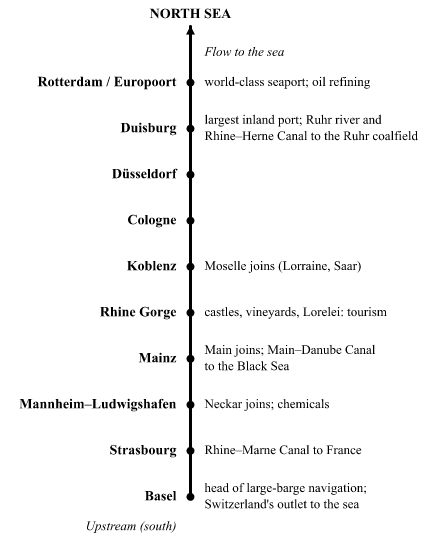 Fig.: The Rhine waterway, Basel to the North Sea (sketch, not to scale)Model answerIntroduction: The Rhine is the busiest inland waterway in Europe, linking Switzerland, France, Germany and the Netherlands to the North Sea.1. Cheap bulk transportBarges carry coal, iron ore, oil, chemicals, grain and containers at low costThis cuts production costs for industries along the river2. Growth of industryThe Ruhr iron, steel and engineering region grew on cheap Rhine transport of coal and oreChemical works at Ludwigshafen (BASF), Leverkusen and Basel3. Growth of portsRotterdam–Europoort is Europe's largest seaport; Duisburg is the world's largest inland portPorts create jobs in handling, storage and services4. Trade and integrationLandlocked Switzerland and eastern France reach the sea through the RhineThe waterway joins the economies of the EU countries5. Links to other waterwaysCanals (Rhine–Herne, Dortmund–Ems, Rhine–Marne) and the Main–Danube Canal (1992) link the Rhine to other regions and the Black Sea6. Hydro-electric powerPower stations on the upper Rhine (e.g. Kembs) and Swiss tributaries supply industries and towns7. Water supplyWater for factories, cooling power stations, homes and irrigation8. TourismCruises through the Rhine Gorge (UNESCO World Heritage, 2002) with castles, vineyards and the Lorelei rock9. AgricultureVineyards on sunny valley slopes and fertile flood-plain farms send produce by river10. Growth of townsRotterdam, Duisburg, Düsseldorf, Cologne, Mainz, Mannheim, Strasbourg and Basel grew as river towns11. EmploymentBarge crews, dock workers, shipbuilders and service workersLimits and problemsPollution from industry and accidents (Sandoz chemical spill, Basel, 1986)Floods (1993, 1995) and low water in droughts (2018, 2022) stop or lighten bargesCongestion and competition from road, rail and pipelinesIf you choose the St. Lawrence Seaway:Opened in 1959, it links the Atlantic to the Great Lakes through locks (Montreal to Lake Ontario, plus the Welland Canal)Carries iron ore from Labrador–Quebec to Great Lakes steel works and grain from the Prairies (Thunder Bay, Duluth) to the worldHEP from the Moses–Saunders power dam; growth of ports such as Montreal, Toronto, Hamilton, Cleveland, ChicagoLimits: frozen from about late December to March; locks limit the size of shipsConclusionThe Rhine has contributed greatly to the development of Western Europe: it is the backbone of its trade and heavy industry, though pollution, floods, low water and competition limit its value.Answer:To a large extent: cheap bulk transport, industry, ports, trade, canal links, HEP, water, tourism, towns and jobs; limited by pollution, floods, low water and competition.Tip:'Assess' needs both contributions and limitations, then a clear judgement.
© africaexams.com
Go to Question:
Advertisements